

Bloons
Loading game…
Bloons
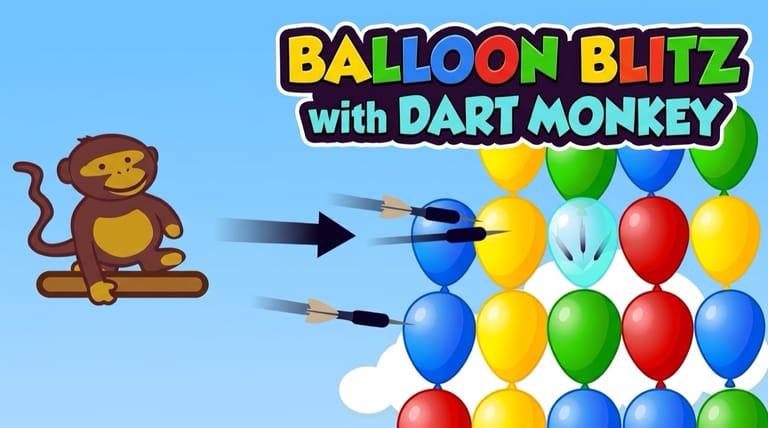
Before any of the tower defense spin-offs existed, Bloons was a throwing puzzle. You get one monkey standing on a small platform, a fixed number of darts, and a wall of balloons arranged in a shape somebody clearly spent time on. Every stage asks the same narrow question: can you burst the required number of bloons with the darts you were handed? There is no drip-feed of extra ammunition and no second chance once the last dart falls off the bottom of the screen, so the whole game lives in the moment between drawing back and letting go.
The Dart Monkey's Angle Problem
Aiming is done entirely with one mouse button. Hold it down and an indicator shows the direction and strength of the throw; move the pointer to change both at once; let go and the dart flies. What happens next is ordinary projectile physics. The dart climbs, slows, and drops, so a flat throw covers ground quickly but sags at the far end, while a high lob arrives almost vertically and can drop into pockets a direct shot can never reach.
The second thing to understand is that a dart does not stop when it pops something. It carries on through the gap it just made, which means a single well-lined throw can chew through an entire column of balloons. Almost every stage is designed around that behaviour. When a layout looks impossible for the dart count you have been given, the answer is usually that one throw is meant to travel a long way through a lane, not that you need to be more accurate one balloon at a time.
Controls
| Action | Control |
|---|---|
| Aim and set power | Hold left mouse button |
| Throw dart | Release left mouse button |
Bloon Types and Hazards
The plain coloured bloons simply pop, but the special ones are what turn a wall of balloons into a puzzle.
- Bomb bloons detonate when hit and clear everything in a radius around them. Chaining two or three of these is often the intended solution to a stage.
- Tack bloons spit spikes outward in several directions at once, which makes them far better value than a bomb when the surrounding field is dense but spread out.
- Ice bloons freeze the balloons touching them into solid blocks. A dart bounces straight off a frozen bloon, so you need an explosion nearby to break the ice before those balloons count for anything.
- Obstacles such as blocks and spikes sit in the field to swallow darts, forcing throws around or over them.
Getting More Out of Each Dart
- Look for the longest unbroken line of balloons on screen before you throw anything. That line is your dart budget.
- Fire a deliberate ranging shot early. Watching one dart's arc tells you more about the stage than guessing twice.
- Save bomb bloons for when the field around them has filled in, not when they are sitting near the edge of a cluster.
- Treat ice as an ordering problem: work out which explosion is going to free the frozen section, and do not waste darts on it beforehand.
- If a stage keeps failing by one or two balloons, the fix is usually a different entry angle rather than more power.
Frequently Asked Questions
Is Bloons a tower defense game? No. This is the original arcade puzzle game — you throw darts yourself from a fixed position. The tower defense games that carry the Bloons name came later and play nothing like this.
Can I move the monkey? No. Where the monkey stands is part of each stage's design, and finding the angle from that specific spot is the puzzle.
Why won't my darts pop some of the balloons? Frozen bloons cannot be popped by a dart. Something has to break the ice around them first, which in practice means setting off a bomb bloon nearby.
What happens if I run out of darts before hitting the target? The stage ends and you start it again with the same dart count. Nothing carries over, so a failed attempt is really just reconnaissance for the next one.
Who developed Bloons? Ninja Kiwi, the New Zealand studio whose monkeys-versus-balloons idea started here and then grew into a much larger series.