
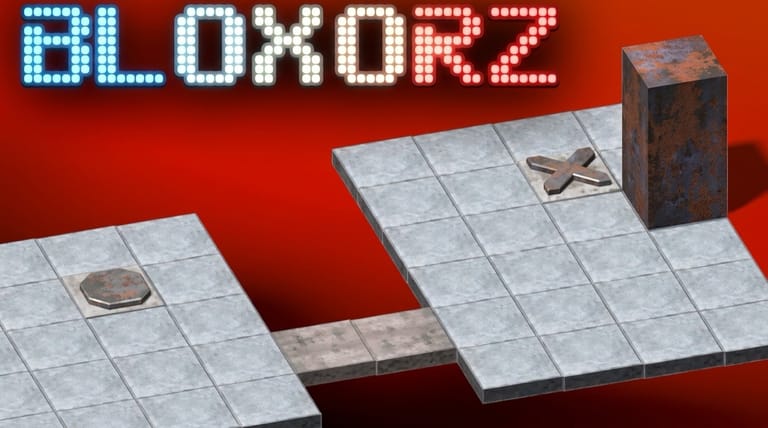

Bloxorz
Loading game…
Bloxorz
The block you are moving is twice as long as it is wide, and every arrow press tips it end over end rather than sliding it. That one detail is responsible for all 33 stages of Bloxorz. A block standing upright occupies a single tile; a block lying down occupies two; and since the floors are narrow strips suspended over nothing, the question is never "can I get there" but "which face will I be on when I arrive". Damien Clarke's puzzle has been passing around school computer labs and office browsers since the late 2000s for exactly that reason — it is trivially easy to understand and genuinely hard to see three moves ahead.
Rolling, Not Sliding
Get comfortable with the geometry before anything else. From upright, one roll puts the block flat; a second roll in the same direction stands it up again. So travelling in a straight line, the block is upright on every other move and each pair of moves carries it three tiles forward. Counting in pairs like this is the fastest way to work out whether a distant hole is reachable at all, because the hole only accepts the block standing on end.
Controls
| Action | Control |
|---|---|
| Roll the block | Arrow keys |
| Switch between split blocks | Spacebar |
Switches, Split Tiles and Fragile Ground
The later stages add hardware, and each piece changes the calculation:
- Round switches are the forgiving kind. Touching one in any orientation, flat or upright, activates it.
- X-shaped switches are heavy switches. They only fire when the block is standing upright on top of them, which usually means the route to reach them matters more than the switch itself.
- Split pads, drawn as a pair of curved brackets, teleport the block and break it into two single cubes. From then on you move one cube at a time and swap between them with the spacebar. Those small cubes are light — they can trip round switches but not the heavy X ones — and finishing the stage means bringing them back together.
- Orange tiles are fragile. They will carry the block lying flat, because the weight is spread across two tiles, but they give way the moment you stand upright on one.
Bridges and gates open and close in response to those switches, and some toggle rather than simply switch on, so hitting the same pad twice can undo work you just did.
How to Think Through a Stage
Solve backwards. Look at the hole, work out which tile the block must be standing on to drop in, then figure out what orientation gets you there. Most stages have exactly one approach that arrives upright, and finding it first removes half the trial and error.
Beyond that: read the tile colours before you move, since a fragile stretch usually needs to be crossed lying flat in a specific direction. Take note of which switches feed which bridges by watching what changes on screen when you step on one. And use the passcode shown in the top right of each stage — it lets you jump straight back to where you were instead of replaying everything you already solved.
Falling off is cheap. The stage restarts immediately, and deliberately rolling off an edge to test your reading of the layout is a reasonable way to learn a tricky board.
Frequently Asked Questions
How many levels does Bloxorz have? Thirty-three, and they escalate steadily as each new mechanic gets introduced.
What is the code in the top right corner for? It is that stage's passcode. Note it down and you can return directly to that level in a later session rather than starting from the beginning.
Why does the block fall through the orange tiles? Those tiles only hold the block when its weight is spread over two squares. Stand upright on one and it collapses.
How do I control the block after it splits into two? Press the spacebar to swap which cube you are steering. Both need to end up back together to finish the stage.
What is the difference between the round and the X-shaped switches? Round switches activate on any contact. X switches need the block standing on end on top of them, and the small split cubes are not heavy enough to trigger them at all.
Who created Bloxorz? Damien Clarke, working as DX Interactive.