

Cubefield
Loading game…
Cubefield
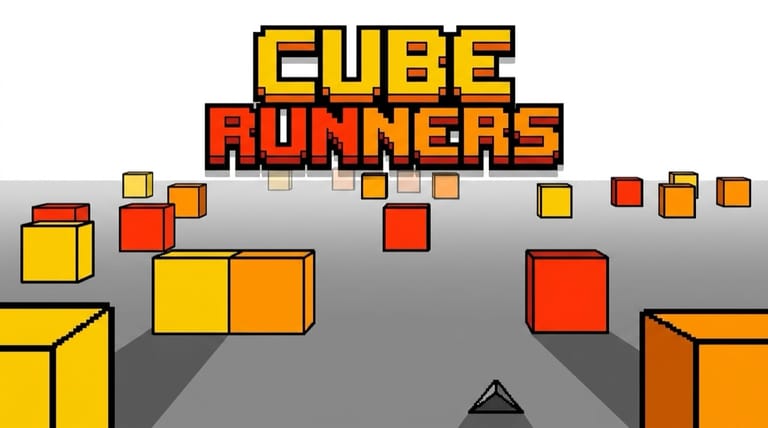
Two keys, one triangle, and an infinite plain of cubes coming at you. Cubefield strips an arcade game down as far as it will go and then relies entirely on how well the remaining part is tuned. There is no scoring system beyond distance, no power-ups, no lives — a single contact with a cube ends the run instantly and you start again from zero speed. YoArcade released it in January 2006, and it became one of the games people kept a tab of open at school and work precisely because it needed nothing: no instructions, no setup, and about four seconds to load.
Two Keys and No Finish Line
You cannot slow down and you cannot stop. The only inputs are left and right, plus P to pause, and the ship accelerates continuously as your distance climbs. The run ends the first time you touch anything. That is the complete rule set, and everything interesting about the game comes from how those rules interact with the field in front of you.
Controls
| Action | Control |
|---|---|
| Steer left | Left arrow |
| Steer right | Right arrow |
| Pause | P |
How the Difficulty Actually Ramps
Two things escalate together. The speed rises with distance, which shortens the time between seeing a gap and needing to be in it. Separately, the field itself changes character — cubes arrange into denser blocks and narrower corridors, so the gaps get smaller at the same moment you have less time to reach them.
The colour palette shifts at intervals as you progress, and it is worth treating those shifts as more than decoration. They are the game's only progress meter. Reaching a new colour means you have passed a threshold, and it is a useful cue to check your grip and reset your concentration rather than a reason to celebrate mid-run.
The Perspective Trick
New players often blame the controls, and understanding why they feel odd is the single biggest improvement available. The ship sits low and near the centre of the screen, and steering does not really move it across the field so much as roll the whole field around it. The horizon banks, the cubes sweep sideways, and the visual effect is that a small input looks like a large one.
The consequence is that holding an arrow key down keeps turning, and turning further than you meant to is the most common way runs end. Short taps give you far more control than sustained presses.
Getting Deeper Into the Field
- Look at the horizon, not the ship. Your reaction time is set by how early you spot a gap, and the gap is at the top of the screen.
- Commit early. Picking a lane while it is still distant and drifting into it gently beats a late correction every time.
- Take the near gap. Chasing a wider opening across the screen usually costs more than squeezing through the one already in front of you.
- Stop over-correcting. After a dodge, resist the urge to immediately steer back. Let the field settle.
- Pause with P before you are tired. Runs almost never end because the game got too hard; they end because concentration slipped at high speed.
Frequently Asked Questions
Does Cubefield have an ending? No. It runs until you hit something, which is why it is an endurance game rather than one you complete.
What is my score based on? Distance travelled. The further you get before a collision, the higher the result.
Why does the screen keep changing colour? The palette changes as you pass distance thresholds. It is the game's way of showing progress in a run that otherwise has no milestones.
Can I pause mid-run? Yes, P pauses. Using it is not cheating and it is the easiest way to extend a long attempt.
Does holding an arrow key steer harder than tapping it? It steers further, because the turn continues as long as the key is down. Taps are more precise and are what long runs are built on.
Who made Cubefield and when? It was developed by YoArcade and originally released in January 2006.