

Diner Dash
Loading game…
Diner Dash
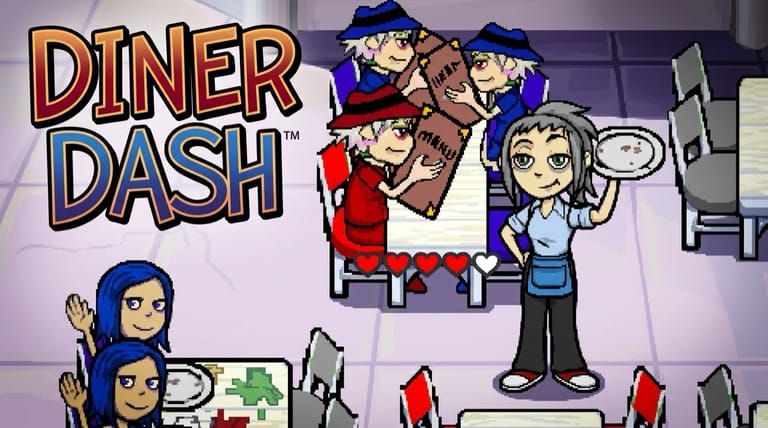
Almost every restaurant-management game you have played since 2004 owes something to Diner Dash. Flo quits a desk job to take over a run-down diner, and the game hands you the least glamorous half of that job: seating people, carrying plates, and bussing tables fast enough that nobody walks out. It was published by PlayFirst and built by the studio Gamelab, and it turned a very ordinary set of chores into a genre.
Flo's Diner and the Service Loop
A shift is a queue of customers and a floor of tables, and every guest moves through the same fixed chain of steps. You seat them, they read the menu, you take the order, you carry it to the pass, you collect the food when the chef rings, you deliver it, you drop the check, you collect the money, and then you clear the plates so the table can be used again. Nothing is automated. Every one of those steps is a click from you.
What makes it a game rather than a checklist is that all of it happens at once. While one table is eating, a second is waiting to order, a third is queued at the door, and a fourth is sitting dirty. Each guest has a row of hearts above their head that drains whenever they are made to wait, and everything Flo can do to them — being seated, being served, being handed the check — resets a little of that patience. Empty the hearts and they leave without paying, which costs you the sale and the tip.
Colour Matching and Chains
The scoring system is where Diner Dash gets its depth. Guests arrive wearing a colour, and tables have colours too. Seat a red party at a red table and you get a bonus. Do it again immediately and the bonus grows into a chain. The same applies to repeating any single action back to back: take two orders in a row, deliver two meals in a row, bus two tables in a row, and the multiplier climbs.
This puts you in permanent tension with yourself. The efficient route around the floor is rarely the one that chains, and the chaining route often means letting somebody stew. Flo can also carry two plates at once, so grouping deliveries is nearly always worth a short detour. Learning to batch — take both orders, then collect both dishes, then clear both tables — is the difference between scraping the level's minimum target and hitting the expert score.
Controls
| Action | Control |
|---|---|
| Select / interact | Left mouse button |
Click a waiting party to seat them, click a seated party to take or deliver, and click a dirty table to clear it. There are no keyboard commands.
Spending the Takings
Money earned across a shift goes into upgrades that change how the floor behaves rather than just how it looks. A podium keeps queued guests happier while they wait outside, better chairs slow the drain on seated guests, background music and decorations top up patience passively, and extra tables raise your ceiling at the cost of more running around. Choosing upgrades is a real decision: adding capacity before you can handle it will sink you.
Customer types matter just as much. Business diners eat quickly and tip well but have almost no patience. Families are slow and noisy, and seating them beside a quiet party drains the neighbours. Older couples are relaxed but linger. Reading the queue and deciding who goes where is the skill the later restaurants test.
Getting Through the Harder Shifts
- Seat the impatient guests first even if it breaks a colour chain. A lost party is worth more than a lost bonus.
- Clear tables the moment they empty. Dirty tables are invisible income, and clearing two in a row chains anyway.
- Deliver the check early. Guests will not leave until they have paid.
- When the floor is on fire, stop chasing points and just keep hearts topped up. Surviving the shift beats a high score you never bank.
Frequently Asked Questions
What happens if a customer runs out of patience? They leave the restaurant without ordering or paying. You lose the revenue and the tip, and repeated walkouts will drop you under the level's target score.
How does the colour bonus work? Seating a party at a table matching their colour awards extra points, and seating consecutive parties at matching tables builds an increasing chain bonus.
Can Flo carry more than one thing at a time? Yes. She can hold two plates, so collecting a pair of meals from the pass and delivering them on one trip is faster than two separate runs.
What do the upgrades between levels actually do? Most slow the rate at which patience drains — the podium for the queue outside, better seating and decor for guests already seated. Extra tables raise capacity instead.
Who made Diner Dash? It was developed by Gamelab and published by PlayFirst in 2004, and it became the template for a long run of sequels and imitators.
Is there an ending, or does it run forever? It is a level-based campaign. Each restaurant is a set of shifts with score targets, and clearing them moves Flo up to a new venue.