
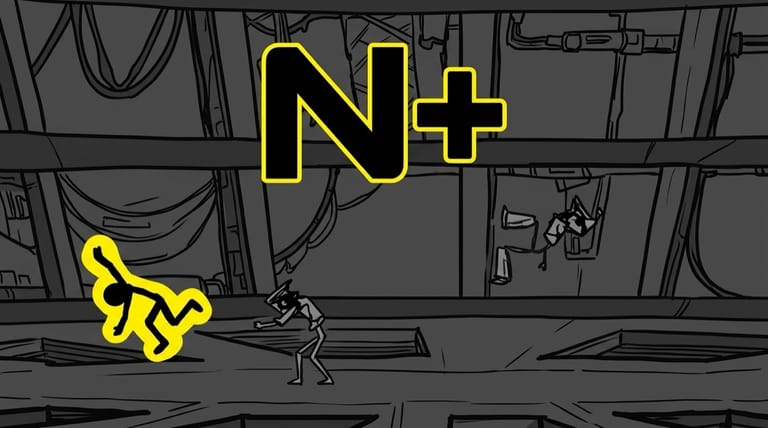

Electric Man
Loading game…
Electric Man
Most stick-figure fighters give you one punch and a lot of enthusiasm. Electric Man gives you a move list. Damien Clarke — the developer better known for the sliding-block puzzle Bloxorz — built a tournament brawler in which the same six keys produce completely different attacks depending on which way you are facing and whether you are moving, and the result is a game with far more depth than its art style suggests.
Six Buttons, Dozens of Moves
Before your first fight you name your stickman, pick his colour, and choose a difficulty of easy, normal, or pro. Then there is a short tutorial, and it is worth doing even if you normally skip them, because the control scheme is not self-evident.
Three keys — A, S and D — throw fast attacks. Three more — Q, W and E — trigger slow-motion attacks that hit considerably harder and freeze the action into a stylised, drawn-out animation. What each key actually does depends on context. Standing still and pressing A produces one thing; running toward an enemy and pressing A produces another; being behind them changes it again. There is no combo notation to memorise, but there is a real move set hiding in there, and players who only ever mash A from a standstill will hit a wall quickly.
Managing the Battery
The slow-motion attacks draw from a battery gauge that refills on its own over time. This is the resource the whole game is balanced around. Slow-motion moves are strong enough to clear space and end an exchange, but if you burn the meter on the first enemy you meet you will be standing in a crowd with nothing but quick attacks and no way to reset the situation.
The right habit is to treat the battery as an emergency budget. Quick attacks handle single opponents perfectly well. Slow-motion is what you spend when three enemies have surrounded you, when you are being juggled, or when you need to close distance across the arena in a hurry. Letting the gauge sit full while you grind through a fight with A and D feels wasteful, but arriving at the last enemy of a round with a charged meter is how difficult stages get cleared.
Controls
| Action | Control |
|---|---|
| Move | Arrow keys |
| Quick attacks | A, S, D |
| Slow-motion attacks | Q, W, E |
Movement direction and your position relative to an opponent change what each attack key produces, so the same button is effectively several moves.
Fighting Crowds
Levels escalate by throwing more opponents at you rather than tougher individual ones, which changes the problem from a duel into crowd control.
- Keep moving through the arena. Standing in the middle of a group means being hit from both sides. Run past enemies to reposition so they line up on one side of you.
- Use the walls. Backing an opponent into the edge of the arena limits how they can respond and stops them circling behind you.
- Do not finish a lone enemy with slow-motion. Save it for the moment two or three converge, when a single wide attack is worth several exchanges.
- Watch the gauge, not the health bar. Recovering from low health is possible; recovering from an empty battery in a crowded arena usually is not.
- Start on normal. Easy hides how much the move set matters, and pro will punish you for not knowing it yet. Normal is where the game teaches properly.
Why It Stood Out
Stick figure animation was everywhere in the Flash years, largely because it was cheap to produce and forgiving to animate. Electric Man is one of the titles that took the aesthetic seriously: the slow-motion sequences are choreographed rather than generic, and the fact that they cost a resource means you see them at the moments that matter instead of constantly. It was popular enough to produce a sequel, and the core of it — a small key set concealing a large move list — is still a smart piece of design to play through today.
Frequently Asked Questions
What do the Q, W and E keys do? They trigger slow-motion attacks, which are stronger than the quick attacks on A, S and D but consume battery power.
How do I recharge the battery? It refills automatically over time during a fight. There is no pickup to collect, so the only way to have energy available is to spend it sparingly.
Why does the same key do different things? Attacks change based on whether you are moving, which direction you are facing, and where you are in relation to your opponent. That is how a six-key layout produces a full move set.
Which difficulty should I choose first? Normal. Easy lets you win without engaging with the move set, and pro assumes you already have.
Should I do the tutorial? Yes. The relationship between movement and attack output is not obvious from the key list alone, and the tutorial demonstrates it directly.
Who created Electric Man? Damien Clarke, who also made the puzzle game Bloxorz.