
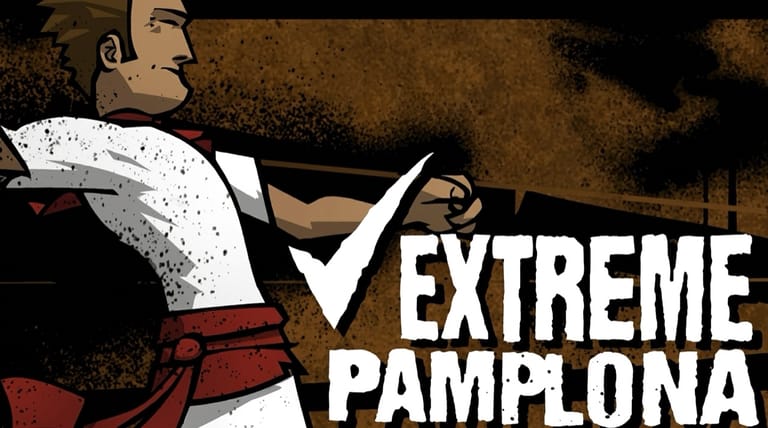

Extreme Pamplona
Loading game…
Extreme Pamplona
There is a herd behind you and it is faster than you are. Extreme Pamplona builds an entire running game out of that one fact, borrowing its premise from the annual bull run through the streets of Pamplona and then sending the idea on tour to a series of increasingly unlikely locations. You cannot outrun what is chasing you indefinitely. You can only clear the obstacles cleanly enough to stay ahead of it for one more stage.
Running Ahead of the Herd
The controls are three keys, and the whole game lives in the space between them. Right arrow runs forward, left arrow runs backward, and space jumps. Backing up sounds useless in a game about being chased, and mostly it is, but it is occasionally the only way to reset your approach to a jump you have mistimed — at the cost of letting the herd close.
Your runner has weight and momentum, and this is the thing that makes the game harder than it looks. He does not stop instantly and he does not jump from a standstill nearly as well as he does at speed. A hurdle you can clear easily while sprinting becomes impossible if you have hesitated in front of it, which means the safest-feeling action — slowing down to look at an obstacle — is usually the one that ends the run.
Reading the Course
Stages are laid out as a sequence of hazards rather than a continuous scroll of the same thing: fences, gaps, crates, barriers at different heights, and objects that need to be jumped at a specific point. Each stage has its own vocabulary of these, and clearing one is a matter of learning the rhythm rather than reacting quickly.
Because the character is physics-driven, a failed jump does not simply stop you. He trips and tumbles, and the tumble is animated as broad slapstick — flailing limbs, a cartoonish sprawl, and then a restart. It is played as comedy in the same register as an old cartoon pratfall, and it is the game's main source of humour. Falling over is meant to be funny, not punishing, and the restart is quick enough that it stays that way.
Controls
| Action | Control |
|---|---|
| Move | Arrow keys |
| Action / jump / shoot | Space |
Right runs forward, left runs backward, and space jumps. There is no separate sprint key — your speed is simply how long you have been holding a direction.
Stages Around the World
The Pamplona setting is only the opening. Later stages relocate to different cities and countries, each bringing its own scenery and its own obstacle set, and the difficulty climbs steeply as they go. What starts as a few fences on a cobbled street becomes courses where two or three hazards arrive close enough together that you have to plan the whole sequence before you reach the first one.
Some things that help:
- Commit to top speed. Almost every jump in the game is easier at full pace. Hesitation is the primary cause of failure.
- Jump early, not late. The character's arc carries him further than you expect, and the common mistake is pressing space when you are already on top of the obstacle.
- Learn the stage, don't react to it. These are memorisation courses. The second attempt at a stage is always dramatically better than the first.
- Watch the gap behind you. The chase is not decoration — falling over repeatedly in the same spot lets the distance close permanently.
Why It Works
The game is one idea executed with confidence. It does not add collectibles, upgrades, or a currency; it just keeps introducing new arrangements of obstacles and trusting that the momentum system is interesting enough to carry them. It is, and the international stage list keeps the visual variety up. Sessions are short, restarts are instant, and the failure animation is funny enough that losing does not sting.
Frequently Asked Questions
Why can't I clear an obstacle I cleared last time? Almost certainly because you approached it slower. Jump distance depends on your speed, so a hurdle taken at a sprint may be out of reach from a walking start.
What does the left arrow key do in a running game? It runs you backward, which lets you re-approach a jump you have mistimed. The trade is that the herd behind you gains ground while you do it.
Are the stages all set in Pamplona? No. The opening takes its cue from the Spanish bull run, but later stages move to other locations around the world, each with a different obstacle layout.
What happens when I trip? The runner takes a cartoon tumble and the stage restarts from a checkpoint. It is staged as slapstick rather than as a penalty, and getting back in takes a couple of seconds.
Does the difficulty ramp up much? Considerably. Early stages space obstacles out generously; later ones chain them together so that a single mistimed jump ruins the next two as well.
Is there an ending? It is a stage-based game, so finishing the full run of locations is the goal. There is no endless mode.