
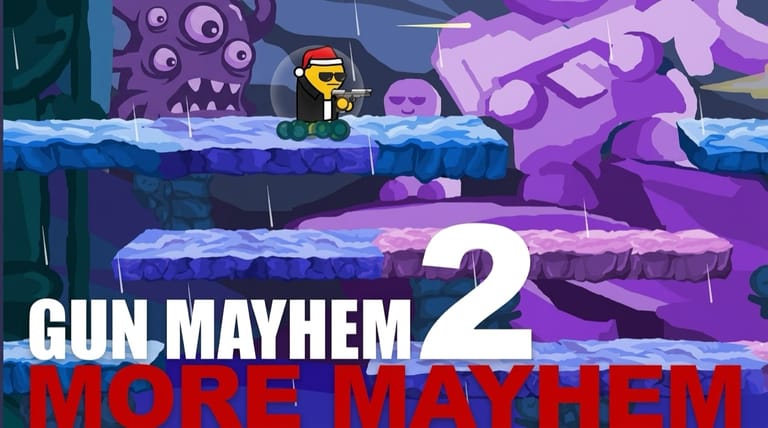

Gun Mayhem 2
Loading game…
Gun Mayhem 2
Sequels to browser games usually amount to more levels. Gun Mayhem 2 went further than that: it kept the knock-them-off-the-platform premise of the original intact and then rebuilt almost everything around it, adding a mode that scores your performance, a much wider character editor, and a control layout that finally put the shoot button somewhere your fingers naturally rest.
What the Sequel Changed
Three differences stand out if you have played the first game recently.
The character editor got serious. Instead of a hat and a shirt, you are now choosing colours, facial hair and full outfits, alongside the mechanical picks — your weapon and your perk. Because the cosmetic layer is broader, the four characters in a local match are much easier to tell apart mid-scramble, which matters more than it sounds when everything on screen is moving.
Modes multiplied. The campaign is longer and its arenas are more varied, custom games ship with a large map pool and a set of rules you can tune, and a separate challenge mode exists purely to test individual skills.
The controls moved. Player one now shoots with Z and uses the secondary with X rather than reaching for the bracket keys. On a standard keyboard this is a straightforward improvement, and it makes four-player crowding around one board slightly less awkward.
Controls
| Action | Control |
|---|---|
| Move and jump | Arrow keys |
| Primary weapon | Z |
| Secondary weapon | X |
| Player 2 move | W A S D |
| Player 2 primary | T |
| Player 2 secondary | Y |
Players three and four take the numeric keypad, using the digit cluster to move with 0 and ., or * and -, handling their weapons.
Challenge Mode and Star Ratings
The challenge mode is the genuinely new idea. Each challenge isolates a skill — accuracy, movement, handling a specific weapon, surviving a particular arrangement of opponents — and grades your run with stars rather than a simple pass. Because the grade is visible, it changes how you play: you stop trying to merely finish and start trying to finish cleanly, which is exactly the discipline that makes you better in a real match.
It also functions as a tutorial the first game never had. Working through the challenges teaches the knockback system, the air-jump limit and the value of the secondary weapon far more efficiently than losing campaign rounds does.
Reading the Arena
The core loop still rewards spatial thinking over shooting accuracy. A few things worth internalising:
- Ledges are the objective. Every exchange should be judged by whether it moves an opponent closer to open air, not by how many shots you landed.
- Weapon crates rewrite the round. A heavy close-range weapon landing next to a crowded platform decides the next ten seconds, so track where crates fall as attentively as you track opponents.
- The secondary is a positioning tool. Use it to create space when somebody is on top of you, or to deny a rival the landing spot they are aiming for.
- Perks reward a plan. Pick one that matches how you actually play instead of the one that sounds strongest, since a speed perk in the hands of a patient player does very little.
- Watch your air jumps. Getting pushed out wide is survivable, but only if you have not already spent your jumps dodging.
Four Players on One Keyboard
Local multiplayer is where this game earned its reputation. Custom matches let you set the stage, opponent count, lives and rules, then hand three friends a corner of the same keyboard. There is no lobby, no account and no waiting — the reason people still load it up is that it delivers a four-player match in about twenty seconds from a cold start.
It arrived in August 2012 from developer Kevin Gu, several years into the Flash portal boom, and the timing shows in how confidently it is built. This is a sequel made by somebody who had already watched thousands of people play the first one and knew which parts they actually used.
Frequently Asked Questions
What does Gun Mayhem 2 add over the original? Broader character customisation, a longer campaign, a much larger custom-game map pool, a star-rated challenge mode, and a revised control layout for player one.
How does the star rating in challenge mode work? Each challenge grades your performance rather than simply passing you, so a clean, efficient run scores higher than one that merely survives.
Did the controls change from the first game?
Yes. Player one's weapon buttons moved to Z and X, replacing the bracket keys used in the original.
Can I play against friends on the same computer? Up to four people can share one keyboard in a custom game, with configurable stages, lives and match rules.
Is customisation purely cosmetic? No. Colours, facial hair and outfits are cosmetic, but the weapon and perk you select genuinely change how your character handles in a match.
Is this a good entry point if I have never played the original? It is the better of the two to start with, because the challenge mode walks you through the knockback and air-jump systems that the first game left you to discover.