

Hobo
Loading game…
Hobo
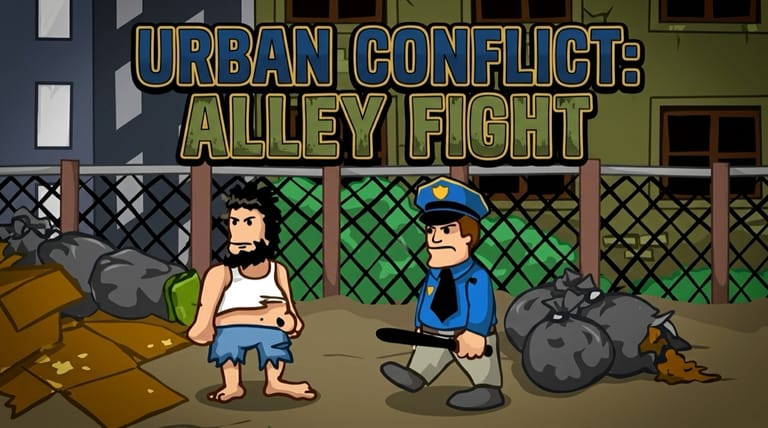
Hobo opens with a man being thrown out of a rubbish container and never bothers to explain itself further. That is the entire setup, and it tells you what kind of game you are getting: a short side-scrolling brawler from 2008 built on deliberately tasteless humour, a combo list that expands as you progress, and no interest whatsoever in a plot.
A Street Brawler With a Crude Streak
The structure is classic arcade beat-'em-up. You walk right through a series of city districts, and the game stops you at intervals until you have dealt with whoever is on screen. Some opponents come at you first, others have to be chased down, and the environment is scattered with props — bins, bottles and other street furniture — that you can pick up and swing.
What separates it from the arcade games it borrows from is the tone. Seething Swarm built the whole thing around gross-out comedy, and a good portion of the moveset consists of joke attacks whose punchline is how undignified they are. It is crude on purpose and it makes no case for itself as anything else; whether that lands depends entirely on your appetite for 2008-era internet humour.
Controls
| Action | Control |
|---|---|
| Move | Arrow keys |
| Punch / pick up an object | A |
| Kick | S |
| Run | Double-tap Left or Right Arrow |
Nearly everything is built from those two attack buttons. Combos are entered as sequences and directional inputs on top of them, which is why the move list can grow substantially without the controls ever getting more complicated.
Unlocking the Combo List
Progression is the moveset. Clearing districts unlocks new combos, and each one is a specific input string rather than a purchased upgrade, so the game is effectively teaching you a small fighting-game vocabulary as you advance. Early on you have little more than a punch and a kick; by the later areas you have a menu of options with different reach, speed and recovery.
That matters because the difficulty comes from being outnumbered rather than from any single opponent being tough. The useful combos are the ones that hit more than one target or reset your position, and learning which of your unlocks does that is the difference between clearing a screen and getting surrounded on it.
Some habits that make the middle of the game easier:
- Check the move list when you unlock something. A combo you never read is a combo you never use, and the newest unlock is usually the answer to the district that just got harder.
- Fight with your back to open ground. Getting pinned against the edge of the screen with enemies on one side is the most common way runs fall apart.
- Pick up a prop before a group fight. Objects give you reach, which is exactly what you lack against three opponents at once.
- Use the run. Double-tapping a direction lets you break out of a crowd and re-engage on your terms rather than trading in the middle of one.
- Turn the difficulty up if the early districts feel trivial. The setting is adjustable, and the game is more interesting when the crowds actually threaten you.
The final district ends with a boss encounter that expects you to have learned the combo list rather than mashing, which is a reasonable exam for a game of this length.
The Series It Started
This is the first of what became a surprisingly long run of games. Sequels followed it into prisons, courtrooms, war zones and eventually outer space, each one keeping the same two-button combo structure while escalating the absurdity of the setting. The first entry is the leanest and the most grounded of them, which makes it the sensible place to start if you want to see what the series actually plays like before the premises get silly.
Its place in Flash history is as a specimen of a particular moment. In 2008 the browser portals rewarded shock value and quick sessions, and Hobo is a very efficient product of those incentives — five minutes to understand, half an hour to finish, and impossible to imagine being greenlit anywhere with an approvals process.
Frequently Asked Questions
Is Hobo the first game in the series? Yes. It was released in October 2008 and was followed by a long run of sequels that moved the same combat system into new settings.
How do I unlock new combos? By progressing through the city districts. New moves are granted as you advance, and each is performed with a specific input sequence rather than bought.
Can I use objects from the street? Yes. Press the pick-up button next to a bin, bottle or similar prop and you can use it in the fight, which gives you extra reach against groups.
Is there a difficulty setting? There is, and it is worth raising if the opening districts are going down without resistance.
Does the game have an ending? It does. The last district finishes with a boss encounter, and the fight assumes you have learned the combos unlocked along the way.
Who developed it? Seething Swarm, a Flash-era studio whose output leaned heavily on this same brand of deliberately tasteless humour.