
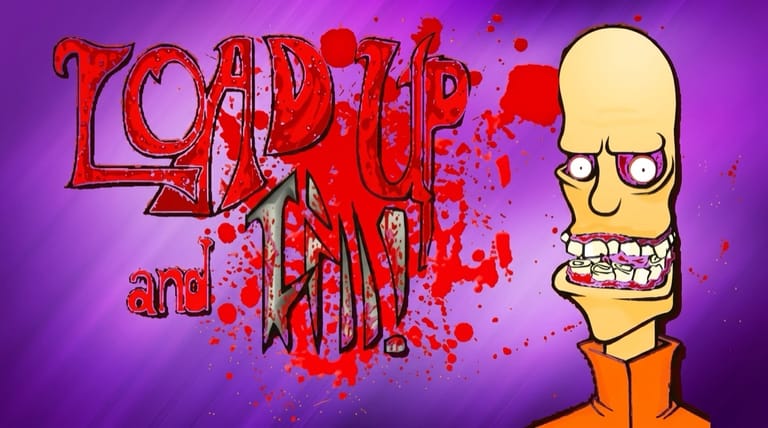

Load Up and Kill
Loading game…
Load Up and Kill
Almost every Flash action game abstracted its equipment down to a single click. Load Up and Kill does the opposite: before anything happens, you have to work out how the thing in your hands operates. Release the magazine, seat it, work the slide. Find the switch and hold it until the motor catches. Prime it, pump it, set it. The scenario framing is grim and deliberately so, but the actual interactive content is a set of small mechanism puzzles, and that is a genuinely unusual thing for a 2000s browser game to be built around.
Mechanism first, everything else second
You are shown a rack of implements and pick one. What follows is a discovery problem: the game does not tell you the sequence, so you click parts of the object and watch what moves. Some respond immediately, some only after something else has been done first, and some require you to follow a brief on-screen prompt. Once the item is ready, the scene cuts to its use, which is handled quickly and abstractly, and you are returned to the rack to choose another.
Every implement is modelled differently. A handgun and a chainsaw have nothing in common procedurally — one is a sequence of latches and a slide, the other is a switch, a choke and a pull cord — and the game's content is essentially the variety of those procedures. There is no score, no timer and no order you have to follow. It is a toy box, not a challenge.
Controls
| Action | Control |
|---|---|
| Pick an implement from the rack | Left mouse button |
| Interact with a specific part | Left mouse button on the part |
| Follow an on-screen prompt | Left mouse button |
| Return to the selection screen | Left mouse button |
Why the design is interesting
- Discovery instead of instruction. No tutorial exists. Learning each object by poking at it is the entire loop, which is the same appeal that later drove escape-room and hidden-object games.
- Hitbox literacy. The game rewards noticing which parts of a drawing are clickable. That was a real skill in Flash-era point-and-click, where affordances were often invisible.
- Procedural memory as content. Replay value comes from remembering sequences rather than improving reflexes, which is rare in a genre dominated by timing tests.
- Extremely short scope. Expect a handful of minutes with everything. Nothing is gated and nothing is hidden behind progression.
What to know before you click Play
The scenario is a cartoon prisoner in a cell and the framing is an execution, presented in a flat, deadpan style with no story, characters or dialogue. The game does not dwell on outcomes — each sequence resolves in a moment and returns you to the menu — but the premise alone puts it firmly in the mature end of the Flash catalogue. It is not children's content and was never presented as such. If the subject matter is not something you want to spend five minutes with, the mechanism-puzzle idea it is built on shows up in gentler form in escape-room games and machine-repair titles from the same period.
A note on where these games came from
The mid-2000s portal ecosystem had no meaningful content gatekeeping. Anyone could upload, and shock premises reliably generated clicks, so a whole tier of games existed purely to be edgy in the way a teenager finds funny. Most of them were mechanically empty. The mildly interesting thing about this one is that its author spent the effort on the interaction design instead — the equipment models are researched well enough that they teach you something about how the real mechanisms work, which is more than the premise promises.
Frequently Asked Questions
What am I actually doing in Load Up and Kill? Working out how to operate each item in the rack. The interactive part of the game is the loading and priming sequence for every implement.
How do I know which part to click? Trial and error. Click around the object and watch for parts that move or highlight; some steps unlock others, so a stuck sequence usually means a step earlier in the chain is missing.
Do the items all work the same way? No, and that is the point of the game. Each one has its own procedure, which is where the variety comes from.
Is there a score or an ending? Neither. You can try the items in any order and stop whenever you like.
Is it appropriate for younger players? No. The premise is dark by design and the game belongs to the adult end of the Flash archive.
Who made it? The original release credits no developer that has been reliably recorded, which is common for anonymous portal uploads from this period.