

Madness Accelerant
Loading game…
Madness Accelerant
Krinkels' Madness Combat animations were built around movement that a game engine has a hard time reproducing: figures that snap between poses, weapons that change hands mid-motion, camera cuts timed to the drum track. Madness Accelerant is Tom Fulp's attempt to make that legible as something you control rather than watch, adapting the animated episode Madness Consternation into a side-scrolling action level released in September 2009.
The animation it comes from
Madness Combat started on Newgrounds in 2002 as a series of short films set in a bleached-out version of Nevada, populated by faceless figures in sunglasses. The visual language is austere: near-monochrome greys and whites, heavy black outlines, almost no dialogue, and a soundtrack doing most of the emotional work. Over a decade of sequels it built a cast and a mythology that fans track closely, and it became one of the portal's defining properties.
Fulp, one of Newgrounds' founders, has a long habit of turning the site's popular animations into playable things. Accelerant is that instinct applied to the series' most kinetic entry, and the fidelity it aims for is stylistic rather than mechanical — it wants to feel like the cartoon, not to simulate it.
Free aim, borrowed weapons, one bad problem
The level is a linear side view. You move along it, and opponents arrive in groups; what you carry is whatever the fight has provided, since weapons change hands constantly and there is no loadout screen. Aiming is independent of movement, either on the vertical axis with the arrow keys or freely with the mouse, so a lot of the play is about holding a line of fire while repositioning. Jumping resets your position more than it dodges anything.
Then there is the thing the game is actually named for. Partway through, a creature far outside your weight class enters the level, and the design flips from clearing rooms to keeping distance. You are not equipped to solve it by fighting, so the sequence becomes about movement, momentum and not being where it is going. That escalation — a competent fight followed by an unwinnable one — is lifted straight from how the animations structure their climaxes.
Controls
| Action | Control |
|---|---|
| Walk left / right | Left Arrow / Right Arrow, or A / D |
| Aim | Up Arrow / Down Arrow, or move the mouse |
| Attack | A, or left mouse button |
| Jump | S, or W when using mouse aiming |
| Swap weapon | D, or S when using mouse aiming |
Two control schemes are available. Keyboard-only puts everything on A, S and D with arrow-key aiming; the mouse scheme frees your aim entirely and moves jumping to W. The mouse layout is far easier to be accurate with.
Playing it well
- Pick the mouse scheme. Aiming with two arrow keys is authentic to the era and a handicap. Free aim makes the fights readable.
- Treat weapons as disposable. Do not conserve. Swap to whatever is best for the current group and drop it when it stops being useful.
- Fight at the edge of the screen. Keeping enemies clustered in one direction is the closest thing this game has to a defensive stance.
- Stop shooting during the chase. Once the large enemy is on screen, damage is not the answer. Everything you have should go into movement.
- Learn the spawn beats. The level is fixed, so a second attempt lets you set up before a group arrives rather than reacting to it.
Madness Day and the Newgrounds calendar
Newgrounds runs an annual Madness Day, and for years it produced a September spike of tribute animations, remixes and fan games riding on the series' popularity. Accelerant's September release fits that pattern exactly, and it is a good illustration of how the portal worked: a community event, an official-adjacent game from the site's own co-founder, and a wave of amateur work in the same style all landing in the same week.
Content-wise, this is stylised cartoon action with the series' signature restrained palette. It is aimed at the same teen and adult audience as the animations rather than at children.
Frequently Asked Questions
Which animation is Madness Accelerant based on? Madness Consternation, one of Krinkels' entries in the Madness Combat series. Accelerant reworks it as a playable level rather than retelling it scene for scene.
Did Krinkels make this game? No. Tom Fulp built it, drawing on Krinkels' series. Krinkels is the animator behind the original films.
Can I beat the large creature? The sequence is designed around evasion rather than a straight fight. Treat it as a chase and focus on positioning.
Why are there two different control layouts? Because free aiming needs a mouse and jumping has to move off the arrow keys to accommodate it. The keyboard-only scheme exists for players who prefer it, but it is less precise.
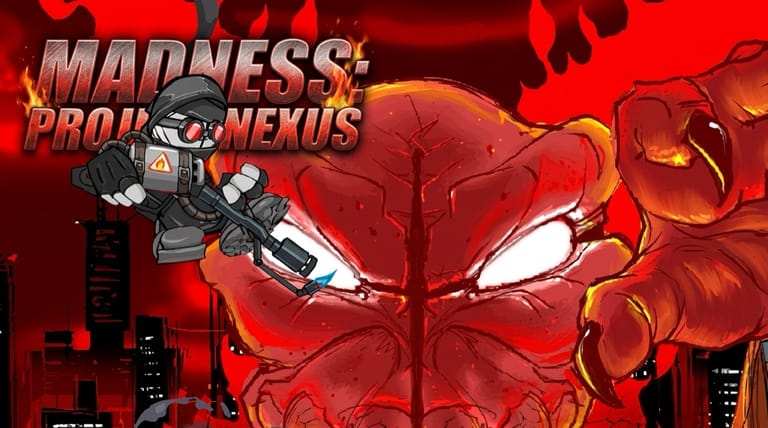
Is this the same as Madness: Project Nexus? No. Project Nexus is a separate, much larger game by Krinkels with a campaign, squads and character progression. Accelerant is a single adapted level.
Do weapons run out? Yes, and that is intentional. Ammunition is finite and the swap key is central to the game because you are expected to keep picking up replacements.