

Madness Project Nexus
Loading game…
Madness Project Nexus
Everything else in the Madness catalogue is a short film or a single level. Madness: Project Nexus is the one with systems — a hired squad, experience points, an equipment economy, an arena mode you can sink hours into, and a story campaign about breaking your agents out of a facility. Krinkels released it in March 2012, and it is the game that proved the series could carry more than a set-piece.
Two games in one file
The campaign is the story mode. It runs through the Nexus facility as a sequence of levels with objectives, escalating enemy types and set encounters, and it is where the plot the series' fans care about actually advances.
The arena is where most of the playtime goes. You create a character, fight waves, and spend what you earn on weapons, armour and hired help. Squad members can be recruited, equipped and levelled independently, which turns the mode into a long-term project: your loadout at wave thirty is the accumulated result of dozens of small purchasing decisions rather than a difficulty setting.
Combat with depth, literally
The view is a side-on room, but you are not locked to a single line. You can move toward and away from the camera as well as left and right, which means fights happen across an area rather than along a groove — flanking is possible, and so is being flanked. Movement is on WASD with the mouse handling aim, so you can back away while keeping a target covered.
The other thing that separates it from a standard side-scroller is that equipment is temporary by design. Firearms hold a finite amount of ammunition and are then worth more as something to throw than to keep, melee weapons are picked up off the floor mid-fight, and switching between the two constantly is the intended rhythm rather than an emergency measure. Interacting with objects and doorways is on the spacebar, and the campaign uses that for objectives as much as for pickups.
Controls
| Action | Control |
|---|---|
| Move | W A S D |
| Aim | Mouse |
| Attack | Left mouse button |
| Interact / pick up | Spacebar |
Making a squad that survives
- Spend on armour before weapons. Guns are everywhere on the floor. Protection is the thing you cannot scavenge, and it is what keeps a run going past the early waves.
- Specialise your hires. Give one squad member reach and another close-quarters gear rather than equipping everyone identically. Mixed squads cover more situations.
- Use the depth axis. Stepping toward or away from the camera breaks a line of fire. Players who treat the arena as a flat corridor take far more damage than they need to.
- Do not hoard ammunition. A weapon you are saving is a weapon not doing anything. Empty it, throw it, take the next one.
- Level the character you actually play. Experience spread thin across a large squad produces a team where nothing is good at anything.
- Learn which enemies need which answer. Armoured opponents and fast ones want opposite approaches, and the arena mixes them deliberately once you are past the opening waves.
From Flash to a full sequel
Project Nexus did well enough that a follow-up was crowdfunded the year after its release, and after a long development the sequel arrived as a full commercial release on Steam in 2021 — a rare case of a Flash game leading to a standalone paid game a decade later, with the same creator still attached. The Flash original remains the more compact version of the idea, and the one that established the arena-plus-campaign structure the sequel expanded on.
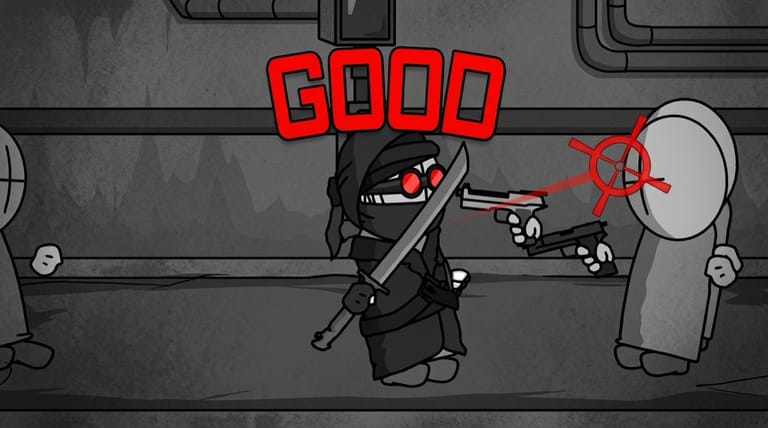
As with the rest of the series, the presentation is stylised: flat grey environments, black figures in sunglasses, motion doing all the characterisation. It is made for the teen and adult audience the animations were made for, not for children.
Frequently Asked Questions
How is Project Nexus different from the other Madness games? Scale and systems. It has a story campaign, an arena mode with waves, squad recruitment, character levelling and an equipment shop, where the other titles are single levels or animation pieces.
What is arena mode? An open-ended wave mode where you build and equip a squad over time. It is the game's main source of long-term play, separate from the campaign.
Can I control my squad members? You play one character directly; hired members fight alongside you and are managed through their equipment and levelling rather than through direct commands.
Do weapons run out of ammunition? Yes, and the design assumes it. Emptied firearms become throwable, melee weapons are picked up as you go, and constant swapping is how combat is meant to flow.
Did Krinkels make this himself? It is credited to Krinkels, the creator of the Madness Combat animations, which is why it hews much closer to the series' canon than fan-made entries do.
Is there a sequel? Yes. A crowdfunded follow-up was released commercially on Steam in 2021, long after this Flash version.