
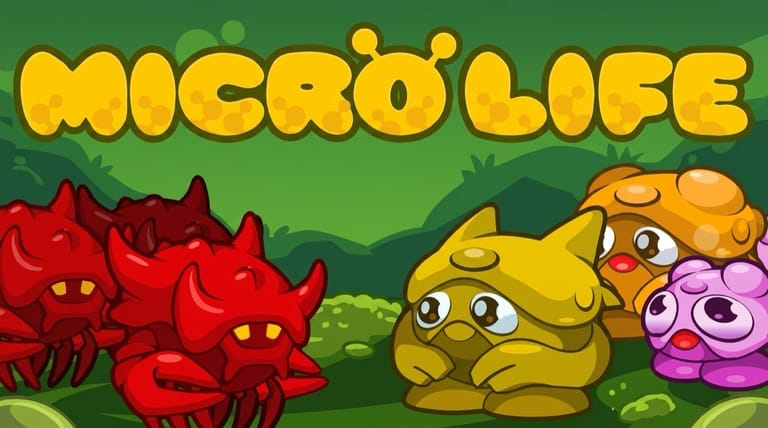

Microlife
Loading game…
Microlife
Microlife runs on a loop so tight it is almost a closed system: your creatures need food, food needs coins, and coins come from the eggs the creatures lay once they are well fed. Break the chain anywhere and it collapses. Kerb's little arcade toy never explains this in a tutorial screen — it just hands you a dish of microbes and a shrinking wallet and waits to see whether you work it out before they starve.
Feeding a Colony You Cannot Pause
You feed by holding the left mouse button and dragging, which drops nutrient across the dish rather than into a specific mouth. That input choice is the whole game in miniature. You are not commanding individual creatures, you are managing a distribution problem: food dropped in one corner feeds whatever happens to be swimming there, and the ones on the far side keep getting hungrier while you do it.
Well-fed creatures grow. Growth is what makes them productive, and a colony of grown creatures produces eggs faster than a colony of stunted ones. But growth also raises the running cost, so the population you can sustain is capped by how efficiently you are converting coins into fed mouths rather than by how many creatures you can crowd into the dish.
Starvation is the failure state, and it is a slow one. Nothing dramatic happens the moment a creature goes hungry — the colony simply stops producing while your reserves keep draining, and by the time the problem is visible you are usually already behind. Learning to notice the early signs is most of what improving looks like.
The Egg Economy
Eggs are your only income. They appear over time from healthy creatures, and you convert them by clicking to collect and exchange them for coins. Uncollected eggs are dead capital, so the rhythm of a good run is a constant sweep: feed, scan for eggs, harvest, feed again.
Two things about the economy are worth internalising:
- Income is proportional to how long the colony has been healthy, not how much you just spent. A burst of feeding after a lean stretch does not retroactively recover the eggs you did not get. Consistency beats rescue spending.
- Your coin reserve is a buffer, not a score. Sitting on coins while creatures go hungry is the most expensive mistake available. The money exists to be spent.
That makes the interesting decision a familiar one from resource games: how thin do you run your reserve to keep production maxed? Play too cautiously and you starve slowly with money in the bank. Play too aggressively and one bad stretch bankrupts you.
Controls
| Action | Control |
|---|---|
| Feed the micro | Hold the left mouse button and drag |
| Collect an egg | Click it |
Getting Further Into a Run
- Feed in sweeps, not dots. Dragging across the dish spreads nutrient over a wider area and reaches creatures that are drifting apart. Parking the cursor in one spot overfeeds two creatures and neglects the rest.
- Harvest before you feed. Collecting eggs first means you are spending money you already have rather than money you are about to have.
- Watch the slowest creature, not the fastest. Colony output is limited by the ones falling behind, so a quick pass over the neglected side of the dish is worth more than another pass over the thriving side.
- Do not chase population early. A small, consistently fed group out-earns a large, half-starved one, and expansion is much cheaper once your income is stable.
Microlife belongs to a small family of Flash-era desktop toys — things you leave open in a tab and dip into — but it is more demanding than most of them because the clock never stops. It is a nice example of how little a browser game needed in order to be genuinely engaging: one input, one currency, one resource, and enough tension between them to keep you watching.
Frequently Asked Questions
Who made Microlife? It was developed by Kerb, a studio that produced a run of browser and casual games during the Flash era.
How do I earn coins? By collecting the eggs your creatures produce and exchanging them. There is no other income source, so a colony that stops laying eggs is a colony that stops paying for itself.
What happens if I run out of money? You cannot buy food, and the creatures begin to starve. If there are uncollected eggs still in the dish, gathering them is the fastest way back into the black.
Why aren't my creatures growing? They are probably not receiving enough food, or the food is landing away from them. Drag across the whole dish rather than releasing it in one place.
Is there an end to the game? It is built as an endurance loop rather than a campaign with a finish line — you play to keep the colony going and to see how far the economy can be pushed.