
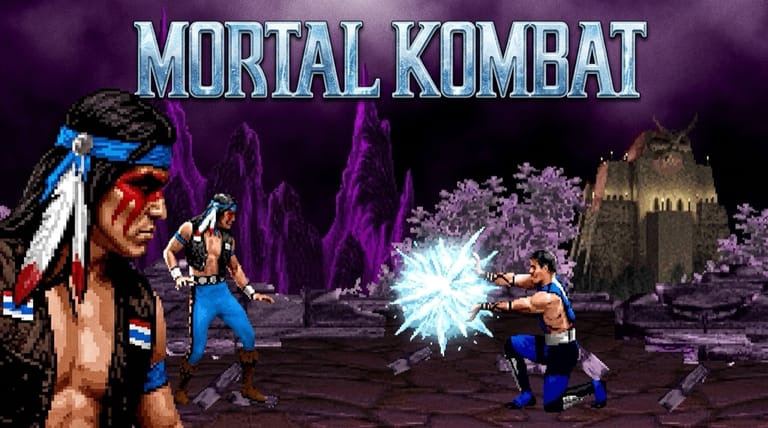

Mortal Kombat Karnage
Loading game…
Mortal Kombat Karnage
Fan-made fighting games were one of the defining oddities of the Flash portal era. A small team with no licence, no budget and a copy of Flash MX would rebuild the fighters they loved from scratch, upload the result for free, and let it circulate. Mortal Kombat Karnage is one of those projects: an unofficial two-dimensional fighter whose roster is drawn from the Mortal Kombat series, made by fans rather than by the people who own the franchise.
It is worth stating that plainly up front. This is not a port, not a demo, and not an official release. It is a tribute made independently, with no affiliation with or endorsement from the rights holders of Mortal Kombat, and it takes obvious liberties with balance, animation and move sets that no licensed release would.
An Unofficial Fan Fighter
What fan fighters like this offered was access. In the mid-2000s, playing a Mortal Kombat game meant owning a console or an arcade cabinet. A browser version that loaded in twenty seconds on a school computer meant anybody could poke at the format, and a whole cohort of players first learned what a blocking button was in a game like this one rather than on a Sega Genesis.
The trade-off is depth. Flash fighters run on much simpler systems than the games they imitate — no frame-accurate cancel windows, no deep combo trees, no input buffering to speak of. What you get instead is a clean, readable version of the fundamentals: two health bars, a round timer, one character each, and a fight decided by spacing and timing rather than by memorising long command strings. As a violent fighting game it carries the tone of the series it borrows from, and it is aimed at players comfortable with that.
How a Match Plays Out
Select a fighter, and the game drops you into a one-on-one bout against an opponent from the same roster. Reduce their health bar to nothing and the round is yours; matches then continue up a ladder of opponents. Movement is walking, jumping and crouching, offence is a punch and a kick, and defence is a dedicated guard key rather than the walk-backwards blocking used by some fighting series.
That dedicated guard button is the most important thing to internalise, because it changes the rhythm completely. You are not holding a direction to defend, you are holding a key, which means you can block without giving up ground and you can be caught defending when you meant to move. Learning to tap it rather than sit on it is the difference between an even fight and a slow loss.
Controls
| Action | Control |
|---|---|
| Move left / right | Left / Right arrow keys |
| Jump | Up arrow key |
| Crouch | Down arrow key |
| Punch | A |
| Kick | D |
| Guard | S |
| Confirm menu selection | Left mouse button |
Getting Better at the Ladder
- Fight at the edge of your kick range. The most common mistake is walking straight into the opponent. Standing just outside their reach and stepping in to attack turns every exchange in your favour.
- Punish the landing, not the jump. A jumping opponent is committed. Crouching under the jump and attacking as they land is far more reliable than trying to trade in the air.
- Alternate punch and kick. The two attacks have different reach and recovery. Repeating one of them makes you readable to the computer opponent, which adapts to patterns quickly.
- Do not hold guard. Blocking continuously invites the opponent to walk in and take control of the spacing. Tap it in response to a committed attack, then move.
- Use the corners. Pushing an opponent towards the edge of the stage removes their retreat option, and most of the ladder's tougher fights are won by taking that ground early.
Frequently Asked Questions
Is this an official Mortal Kombat game? No. It is an unofficial fan project built independently in Flash, with no connection to the studios or publishers behind the Mortal Kombat series.
How do I block? Hold the S key. Blocking is a dedicated button here rather than something you do by walking backwards.
Do the characters have special moves? Fan fighters of this vintage generally implement a small handful of them at most, and they vary by build. The reliable tools are the standard punch, kick and jump attacks.
Is it two-player? The game is built around fighting computer opponents through a ladder of matches on a single keyboard.
Why does it feel less precise than a console fighting game? Flash was never designed for frame-accurate fighting input. Timing windows are looser and animations are simpler, which makes these games easier to pick up and less deep to master.