

Puzzle Bobble
Loading game…
Puzzle Bobble
The rule that makes Puzzle Bobble a great game rather than a pleasant one is that bubbles fall when nothing is holding them up. Matching three of a colour pops them, which everyone works out in the first ten seconds. Realising that popping the right three can drop twenty more that were only attached through them is the moment the game opens up, and it is the difference between clearing a board and clearing it well.
Taito's Spin-Off That Outgrew Its Parent
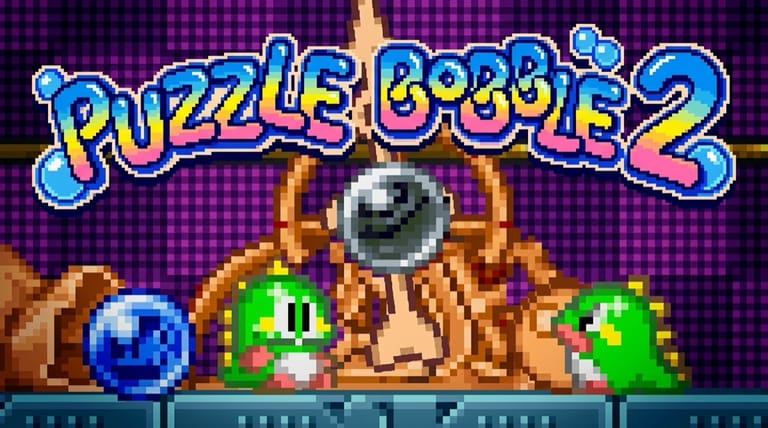
Taito released Puzzle Bobble in arcades in 1994, starring Bub and Bob from Bubble Bobble — the same dragons, redrawn, now firing bubbles from a launcher instead of running through platform stages. Outside Japan it was mostly sold as Bust-A-Move, which is why the same game answers to two names. Even the music is a callback: the main theme is a rearrangement of the Bubble Bobble tune, which is a large part of why it is so instantly recognisable to people who have never played either game properly.
It became one of the most ported puzzle games ever made and effectively defined the bubble shooter as a genre. Almost every match-three shooter since is working from this template.
How a Board Is Won
A cluster of coloured bubbles hangs from the top of the screen. Your launcher sits at the bottom, you rotate it left and right, and you fire. Three or more bubbles of the same colour touching each other pop on contact.
The second rule is the important one. Any bubble left with no connected path back to the ceiling has nothing to hold it up and falls, and falling bubbles are worth more than popped ones. Whole sections of a board can be brought down with a single well-placed shot at a supporting bubble.
Working against you is the ceiling. After a set number of shots it drops a row closer, and if the cluster reaches the line at the bottom of the play area the round ends. Missed shots stick to the board and make the situation worse, so accuracy has a compounding cost.
Controls
| Action | Control |
|---|---|
| Aim the launcher | Left and Right arrow keys |
| Fire a bubble | Spacebar |
Playing the Angles
- Bank off the walls. The side walls reflect bubbles cleanly, and a bank shot is the only way to reach a pocket tucked under an overhang. This is the single most useful skill in the game.
- Shoot the supports, not the surface. Look for the bubble that a large group is hanging from and attack that colour instead of clearing the front row.
- Use the next-bubble preview. You can always see what is coming after the current shot, so plan two moves rather than one — setting up a colour with a deliberately safe placement is often better than a marginal pop now.
- Eliminate colours completely. Once no bubbles of a given colour remain on the board, the launcher stops handing you that colour, which sharply improves the odds on every subsequent shot.
- Do not park bubbles at the edges. Stray shots on the far left and right widen the cluster and cost you the wall angles you need later.
Why It Endures
Puzzle Bobble is one of a small number of puzzle games where the skill ceiling is physical as well as mental. Knowing which bubble to hit is a planning problem; hitting it off two walls under a descending ceiling is an aiming problem, and the two never stop reinforcing each other. That is a rare structure — most puzzle games are one or the other.
It is also unusually kind about pace. There is no clock in the traditional sense, only the shot counter that lowers the ceiling, so you can take as long as you want on any individual shot. The pressure is entirely of your own making, which makes losing feel like something you did rather than something that happened to you.
Frequently Asked Questions
Why is it also called Bust-A-Move? Taito used the Bust-A-Move name for most Western releases while the Japanese original kept Puzzle Bobble. They are the same game and the series has been sold under both names for decades.
Who are the two characters? Bub and Bob, the dragons from Taito's Bubble Bobble. Puzzle Bobble is a spin-off from that series and reuses its cast and musical theme.
Why did a big chunk of the board disappear at once? Because you cut its connection to the ceiling. Bubbles that are no longer attached to the top fall away, and they score more than bubbles you pop directly.
How do I hit a bubble that is behind an overhang? Bounce the shot off a side wall. Aiming at a shallow angle into the wall lets the bubble travel underneath obstacles that a direct shot cannot pass.
What actually ends a round? The bubble cluster reaching the line near the bottom of the screen. The ceiling steps down after a fixed number of shots, so wasted shots directly shorten your round.