
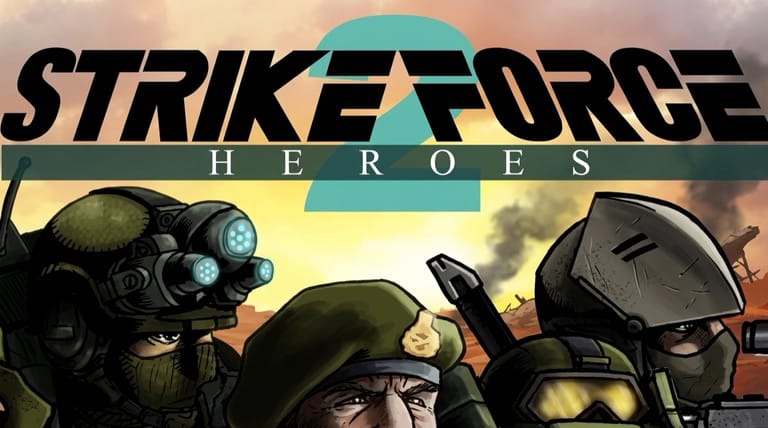

Strike Force Heroes 2
Loading game…
Strike Force Heroes 2
Sequels to browser shooters usually mean more maps. Strike Force Heroes 2 went after the part of its predecessor that players spent the most time staring at: the loadout screen. Instead of a fixed shop list, weapons now drop as randomised rewards with rarity tiers and rolled statistics, and each one can be pulled apart and modified. The shooting underneath is recognisably the same side-scrolling action, but the reason to replay a mission changed completely — you are no longer grinding currency, you are hoping for a better drop.
What the Sequel Rebuilt
Three changes carry most of the weight.
The first is the weapon economy. Finishing missions and challenges awards weapons rather than money, and the pool is enormous. Two rifles of the same model can roll differently, so the arsenal you end up with is genuinely yours rather than a shared list every player works through in the same order. Rarity tiers sit on top of that, marking out which drops are worth building around.
The second is modification. Weapons can be fitted with attachments and tuned, which turns a mediocre drop into something usable and gives you a reason to keep guns you would otherwise sell. It also means the loadout screen supports real experimentation — the same weapon can be set up for close range or for holding a distance.
The third is presentation. Where the original strung missions together loosely, the sequel runs a proper story campaign with cutscenes, named characters and dialogue between missions, plus objective types that vary rather than repeating the same clear-the-map instruction.
Squad Structure and Killstreaks
The squad-of-four framework returns: you control one soldier, and being taken out hands you the next member of the team. Classes come back too, each with its own progression, equipment restrictions and abilities, though the lineup was reshuffled from the first game rather than carried over intact.
Killstreaks are now something you choose. Rather than being handed whatever the class provides, you slot a streak reward into your loadout ahead of the mission, which makes the class-plus-streak combination a deliberate build instead of a fixed pairing. Outside the campaign there is a custom game builder with a long list of modes, adjustable bot counts and difficulty, and a challenge list that pays out drops for completing specific conditions.
Controls
| Action | Control |
|---|---|
| Move | A / D or Left / Right arrow keys |
| Jump | W, Up arrow or Space |
| Crouch | S or Down arrow |
| Aim and fire | Left mouse button |
| Change weapons | Q or Shift |
| Pause or quit | Esc |
Because aiming tracks the cursor continuously, a steady hand matters more than reaction speed. A comfortable mouse sensitivity is worth more here than any single unlock.
Getting Through the Campaign
- Check every drop, sell most of them. The inventory fills quickly. Compare rolled stats against what you are carrying and clear out the rest so the list stays readable.
- Build around one weapon, not four. Modification points are better concentrated on a single strong drop than spread thinly across everything you own.
- Match the killstreak to the map. A reward that dominates an open level can be near useless in a cramped one, and you choose it before the mission rather than during it.
- Level a class you enjoy. Progression is still per class, so committing to one gives you access to its better gear far sooner than sampling all of them.
- Use challenges as a drop farm. They are short, repeatable, and the fastest way to cycle through the loot pool when your current weapon has stopped keeping up.
How It Compares to the First Game
If the original was a class-based shooter with a shop, the sequel is a loot game that happens to be a shooter. The first is tighter and quicker to finish; the second has far more to chase and a campaign with narrative shape, at the cost of time spent in menus. Most players who put serious hours into the series did it here, because the drop system gives a mission a reason to exist after you have beaten it.
Frequently Asked Questions
Do my weapons and progress carry over from the first game? No. The sequel starts fresh, with its own progression and its own weapon pool.
Why do two copies of the same gun have different stats? Drops are randomised. Each one rolls its own values within a range, which is why it is worth checking a duplicate rather than discarding it on sight.
What does modifying a weapon actually change? Attachments and tuning adjust handling, effective range and output, letting you specialise a drop for the role you need rather than accepting it as it fell.
Can I pick which killstreak reward I get? Yes. Streak rewards are selected in the loadout screen before a mission, so you can tailor them to the map and objective.
Is there a multiplayer mode? Not against other people. The custom game builder lets you configure matches against computer-controlled opponents with your choice of mode, map and numbers.
Should I play the first game first? It is not required. The sequel's campaign stands on its own, and its systems are explained from scratch.