

The Unfair Platformer
Loading game…
The Unfair Platformer
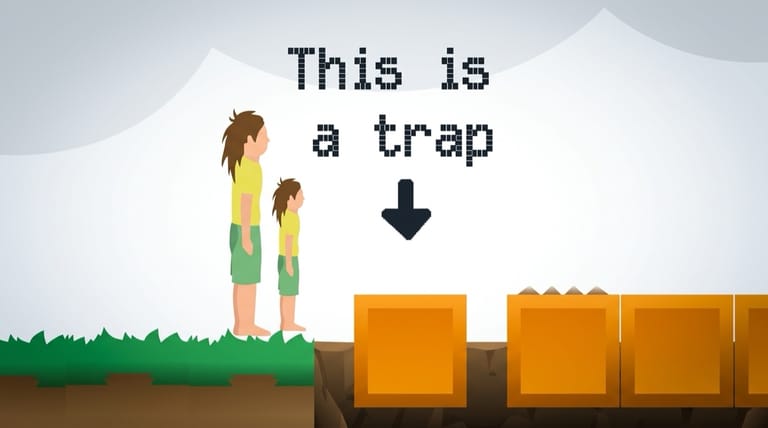
Eggys Games designed The Unfair Platformer around a promise it breaks constantly: that a platform level looks the way it works. The layout in front of you is legible, the jumps are reasonable, and none of it can be trusted. Blocks give way when you land on them, hazards emerge from surfaces that were solid a second ago, and the safest-looking route is regularly the one that kills you. This is a troll platformer, and the traps are the content.
Death Is How the Level Communicates
There is no fair way to play this. You cannot read a screen and deduce where the traps are, because the traps are specifically placed where deduction says they are not. The only information channel is failure: you walk into something, you die, you respawn, and now you know one more thing about the room than you did.
That sounds hostile, and it is, but the design compensates in the way this subgenre always does. Restarts are immediate and cost you nothing but a few seconds. Because the penalty is trivial, dying stops feeling like punishment and starts feeling like scouting. A run that ends in ten deaths and eight new pieces of knowledge is a good run.
The result is that skill in this game is mostly memory. Your reflexes matter for executing jumps you already know are coming, but nobody gets through a fresh screen clean. The player who finishes is the one who kept a mental map of everything that killed them.
The Kinds of Lies It Tells
Once you have played a few screens, the trap vocabulary becomes recognisable even if the placement never does:
- Platforms that are not. Ground that vanishes, drops, or tilts the moment your weight is on it.
- Hazards that arrive late. Spikes that push up out of the floor or down from a ceiling after you have committed to a jump.
- Bait. An obviously convenient ledge, an inviting gap, a clear straight run — placed there because it is obvious.
- Punished caution. Occasionally the trap is set for the player who inches forward carefully rather than the one who charges, which stops any single approach from being safe.
- The moved goalpost. An exit that is not where the level's shape says it should be.
Controls
| Action | Control |
|---|---|
| Move left and right | A / D or Left / Right arrow keys |
| Jump | W or Up arrow key |
Losing Fewer Lives
- Advance in short hops. Small movements limit how far a mistake carries you and make it easier to identify exactly what triggered a death.
- Note the trigger, not just the trap. Knowing a spike exists is half of it. Knowing it fires when you touch a specific tile is what gets you past it next time.
- Take the ugly route. When two paths present themselves, the awkward-looking one is more often survivable than the clean one.
- Test edges deliberately. Nudging into a suspect platform to see whether it holds costs one life and saves several.
- Stop when you tilt. Frustration turns careful probing into repeated identical deaths, which teaches you nothing.
Where It Sits in the Troll-Platformer Tradition
Games built to deceive the player have a small, stubborn lineage — Japanese troll platformers of the mid-2000s and the notoriously hostile PC games that followed them, all working the same joke from different angles. The formula needs two things to function: instant respawns, and a level layout that is fixed rather than random, so that memorisation is actually rewarded. The Unfair Platformer has both, which is why it works as a game rather than just an irritation.
What Eggys Games got right is restraint in length. The traps are inventive enough to stay funny across the run, and the game does not outlast its central joke. It knows that the moment you can predict the next lie, the game is over — so it keeps finding new ones and then ends.
Frequently Asked Questions
Is there any way to spot traps before they trigger? Not reliably. The level art is designed to give nothing away, which is why the game is built around cheap, immediate restarts instead.
Do the traps stay in the same places between attempts? Yes. The layouts are fixed, so everything you learn from a death is still true on your next try. That is what makes progress possible.
Who made The Unfair Platformer? Eggys Games, a developer with a catalogue of browser platformers and puzzle titles from the Flash era.
Does dying set me back very far? No. Respawns are quick and you resume close to where you were, which is what keeps the trial-and-error structure tolerable.
Is this a hard game in the traditional sense? Not in terms of execution. The jumps themselves are ordinary. The difficulty is entirely in not knowing what the level is about to do.