
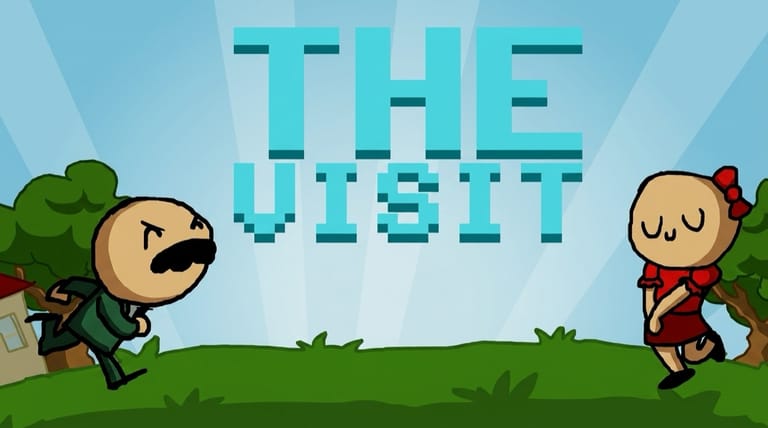

The Visit
Loading game…
The Visit
First, a disambiguation, because two games on this site have nearly the same name. The Visit is a short side-scrolling platformer by Marius Fietzek, Benedikt Hummel and Irina Gross, played with the arrow keys, in which you walk to your girlfriend's house. The Visitor is a completely different game — a point-and-click puzzle series by Zeebarf about an alien parasite. If you are looking for the one where you click on scenery to solve horror puzzles, that is the other page.
A Walk, Not a Gauntlet
What you do here is straightforward. You move right. You jump over things. The distance is not long and the platforming is not demanding, which is deliberate, because the game is not testing your reflexes. It is watching what you do with the one thing it puts in your way.
That thing is crabs. They sit and shuffle along the path in front of you, and every convention you have absorbed from other side-scrollers says they are enemies to be dealt with. They are not. Nothing in the game marks them as hostile, nothing gives you a score for removing them, and nothing tells you that they matter. Most players work out that they mattered only afterwards.
The Endings Are the Content
The Visit has multiple endings, and most of them turn on the crabs — on whether you avoided them, what you did when avoiding them was inconvenient, and how consistent you were about it across the whole walk. That is the design in one sentence: an ordinary platformer that quietly records your habits and then shows you them.
It works because the game withholds the fact that it is doing anything at all. There is no morality meter, no warning, no character stopping to tell you that actions have consequences. You simply play the way you normally play, and then the ending tells you what kind of player that made you. Being told the mechanism in advance would ruin it, which is why almost every write-up of this game is vague — and why the honest recommendation is to play it once without thinking about it before you go looking for the other endings.
The presentation matches the restraint. It is short, quiet, and small in scope, with no combat systems, no upgrades and no score. You could finish a run in a few minutes.
Controls
| Action | Control |
|---|---|
| Walk left | Left arrow key |
| Walk right | Right arrow key |
| Jump | Up arrow key |
Seeing the Other Outcomes
- Do your first run on instinct. Whatever you would normally do in a platformer is the correct approach the first time, because that is the reading the game wants to give you.
- Then run it again deliberately. Change your policy toward the crabs completely and take the same walk. The contrast is the actual experience.
- Watch the jumps you take for convenience. Some of the endings hinge on the moments where avoiding a crab was slightly awkward rather than the ones where it was easy.
- Try being inconsistent. Behaving one way early and differently later is its own path, and it is the one most people never see.
Why a Five-Minute Game Is Worth Your Time
Short games with a hidden behavioural hook were a genuine subgenre in Flash's later years, and they existed because the browser was the only place you could publish something that took four minutes and made one point. This is a good example: a tiny scope, a single idea, and a delivery mechanism that only functions once per player.
It is also a neat piece of game criticism from the inside. Side-scrollers spent thirty years training players that small moving creatures in your path exist to be jumped on, and this game does nothing to that expectation except decline to endorse it. Whatever ending you get on your first run says more about the genre than it does about you.
Frequently Asked Questions
Is this the same game as The Visitor? No. The Visitor is Zeebarf's point-and-click horror puzzle game. This is a short arrow-key platformer by a different team, and the two have nothing in common but a similar title.
Are the crabs enemies? The game never treats them as enemies. They are obstacles at most, and how you handle them is the thing the endings are actually tracking.
Who developed The Visit? Marius Fietzek, Benedikt Hummel and Irina Gross.
How many endings are there? Several, with most of them determined by your behaviour on the walk rather than by any explicit choice you are offered.
How long does one run take? A few minutes. It is designed so that replaying it with a different approach costs you almost nothing.
Is there any combat or scoring? Neither. There is no attack button, no health bar and no score. Walking and jumping is the complete set of things you can do.