
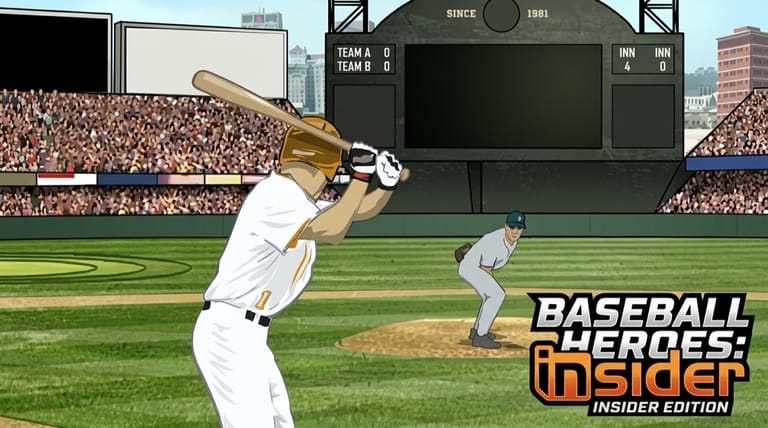

ESPN Arcade Baseball
Loading game…
ESPN Arcade Baseball
ESPN spent much of the 2000s running a small arcade of sports games on its website, and Baseball was one of the tidiest of them. It does not simulate a season, manage a roster, or put you in the field. It gives you a bat, a mouse, and two very different reasons to swing — one about accuracy, one about pressure — and that is the entire package.
Two Modes, One Mouse
The whole game is played with the pointer. Where you put the cursor determines where the bat goes, and the click is the swing. There is no power meter to fill and no directional stick to fine-tune the launch angle, which means the two variables you control are placement and timing. Everything the game asks of you sits inside those two things.
That simplicity is deliberate. It was built to be understood in about four seconds by someone who clicked through from an article, and it holds up for the same reason a good arcade cabinet does: the input is obvious and the difficulty is entirely in the execution.
Controls
| Action | Control |
|---|---|
| Select / interact | Left mouse button |
Position the cursor to aim your swing and click to make contact. Menus and mode selection use the same button.
Precision Hitter
The first mode is a scoring drill. You get ten pitches and a set of targets laid out across the field, and the closer you land the ball to the centre of a target, the more it is worth. Missing entirely wastes one of your ten. There is no defence, no baserunning, and no game situation — just the question of whether you can put the ball where you meant to put it, ten times in a row.
It rewards restraint. The instinct is to swing hard at everything, but a lofted ball that drops on a bullseye scores far better than a screaming line drive that sails past the targets. Learning to take the pitch you cannot place well is worth real points, even though passing on a pitch means burning one of your ten.
Bottom of the Ninth
The second mode drops you into a scenario. Your side is two runs down in the last inning with three outs remaining, and you have to manufacture a comeback from there. Every at-bat is loaded: an out is a third of your remaining game, and there is no next inning to make it up in.
The tension comes from arithmetic. Two runs means you need at least two runners to cross the plate, which usually means either getting on base repeatedly without wasting outs or connecting for something that clears the bases in one swing. Both approaches are viable, and the mode is short enough that you can try them alternately and see which suits your timing.
Getting More Out of It
- Watch the release, not the plate. The pitch tells you where it is going early. Committing your cursor before the ball is halfway there is what causes most whiffs.
- In Precision Hitter, treat the ten pitches as a budget. Two well-placed hits are worth more than eight scattered ones, so there is no shame in a deliberate miss on a pitch you cannot handle.
- In Bottom of the Ninth, protect the outs. A conservative contact swing that puts a runner on is more valuable than a home run attempt that ends the game.
- Play both modes. Precision Hitter builds the placement skill that Bottom of the Ninth then puts under time pressure.
Where It Came From
ESPN Arcade was a collection of short, free sports games published under the broadcaster's own banner, covering baseball, basketball, football and more. They were promotional, but they were also made with a real understanding of what a five-minute browser game needs: one clear input, an immediately readable goal, and a score worth beating. Baseball is a good example of the format, and the two-mode split gives it more life than the single-idea games it sat alongside.
Frequently Asked Questions
What are the two modes in ESPN Arcade Baseball? Precision Hitter, where you have ten pitches to land the ball as close to target centres as possible, and Bottom of the Ninth, a comeback scenario.
How many pitches do I get in Precision Hitter? Ten. Each swing uses one whether or not you make contact, so a wild swing costs you the same as a miss.
What is the situation at the start of Bottom of the Ninth? Your team is two runs behind with three outs left in the final inning, and you have to score enough to win from there.
Do I ever play defence? No. Both modes put you at the plate only. There is no fielding or pitching to control.
Is timing or aim more important? They are linked, but aim decides your score in Precision Hitter while timing decides whether you make contact at all. Poor timing means the placement never gets a chance to matter.
Who made this game? It was produced by ESPN as part of the ESPN Arcade collection of browser sports games.