

Grow Cube
Loading game…
Grow Cube
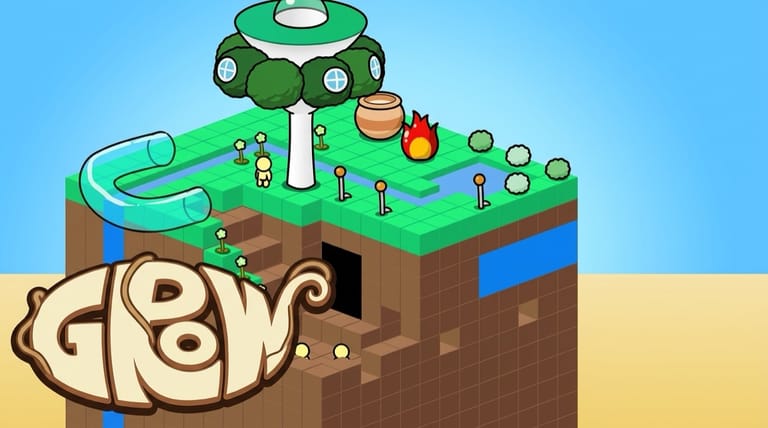
A bare block floats in the middle of the screen and ten small icons sit around it. Click one, and something happens that you did not ask for: water pools, a vine climbs, a little worker wanders out and starts fixing whatever was placed before. Grow Cube never explains a rule, never shows a tutorial, and never tells you that you have made a mistake — it just shows you consequences and waits for you to click again.
The Eyezmaze Game That Everybody Remembers
Grow Cube came out of Eyezmaze, the personal site of a Japanese developer credited simply as On, who spent the mid-2000s releasing hand-drawn browser toys for free. Of everything on that site, the cube is the one that spread furthest — it circulated by word of mouth on forums and in email chains for years, largely because it was impossible to describe without making somebody want to try it.
Its trick is that it withholds instruction without ever feeling unfair. The ten panels are a mix of raw materials and characters: water, fire, a bucket, seeds, a coil, a ball, a little figure who does the labour. None of them are named, and you learn what each one is by using it and watching what the cube does about it.
Controls
| Action | Control |
|---|---|
| Place the next object | Left mouse button on a panel |
That is genuinely the whole interface. There is no dragging, no aiming, and no undo, so the only skill the game asks for is attention.
Why the Order Is the Puzzle
Every object in Grow Cube has levels, and it gains one each time a later placement gives it something to react to. Put the seeds down early and something else will water them; put them down last and they sit there as sprouts forever. Place fire before there is anything to heat and it accomplishes nothing; place it after the right groundwork and it drives the next stage of construction.
That means each of your ten clicks does two jobs at once. It advances the object you just chose, and it feeds — or fails to feed — everything already on the cube. A late placement can level up four earlier things in a single animation, which is the moment the game clicks for most people.
The cube reflects all of it visually. A well-ordered run stacks into terraced architecture with plants, plumbing and machinery threading between the faces; a poorly ordered one leaves a lumpy block with half-finished pieces stuck to it.
Reading the Level Meter
When the run ends, Grow Cube shows a bar for every object with the level it reached. This is the feedback that makes the game solvable rather than random, and it is the part new players skim past.
Use it like a diagnostic:
- Objects stuck at level one were placed too late to interact with anything, or too early for anything to interact with them.
- One tall bar surrounded by short ones means you built a chain that served a single object instead of a network.
- A cluster that all climbed together identifies a genuine dependency group worth keeping in the same relative order next attempt.
The efficient method is to change one thing at a time. Move a single object two slots earlier, replay, and compare the meter against your last run. Ten placements produce far too many orders to brute-force, but the meter turns each attempt into real information.
Getting to the Full Cube
There is a best possible outcome — every object at its maximum, and a final animation that pays off the whole run — and reaching it unaided is why the game has stayed in circulation for two decades. Solution lists exist all over the web, and reading one takes four seconds and removes the entire game.
Two things help without spoiling anything. Watch the animations to the end instead of clicking through, since the little worker's behaviour is the clearest signal of what the cube currently needs. And keep a written list of the order you used, because after three attempts you will not remember which permutation you already tried.
Frequently Asked Questions
How many objects are there in Grow Cube? Ten panels, each placed exactly once per run, which is why the sequence you choose is the entire decision space.
What do the bars at the end of a run mean? They show the level each object reached. Comparing them between attempts is the intended way to work out which placements were too early or too late.
Can I undo a placement? No. Once an object is placed the run continues from there, so a run you have clearly spoiled is best restarted rather than salvaged.
Is there one correct order? There is one order that maxes every object and triggers the full ending sequence. Other orders still finish and still produce a cube, just a less developed one.
Do I need to know what each icon is called? No, and the game deliberately never tells you. Identifying each object by watching what it does on the cube is part of the design.
Which Eyezmaze game should I try after this one? Grow RPG is the natural next step, since it applies the same ordering idea to a fantasy story with a proper antagonist rather than to a construction scene.