

Grow Tower
Loading game…
Grow Tower
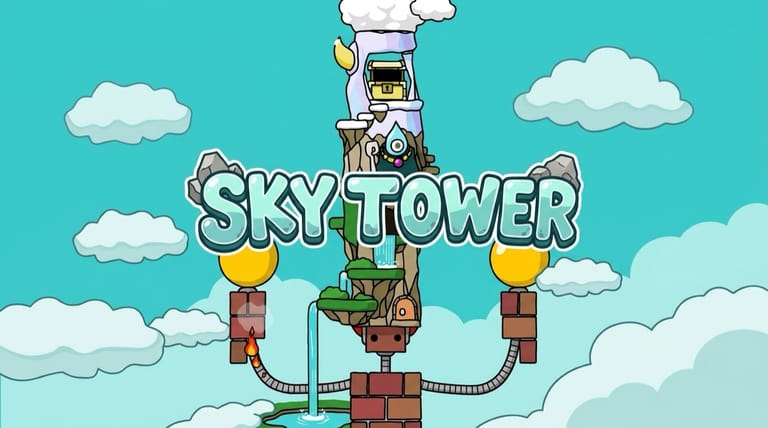
Most of Eyezmaze's puzzles spread outward across a landscape. Grow Tower builds up instead, and that vertical framing changes the whole feel of the thing — every object you add sits on top of what came before, so a mistake is not tucked away in a corner of the scene, it is a visible kink in a structure you have to keep building on.
Short by Design
This was released as one of the smaller entries in the series, and the trimmed scope is deliberate. Rather than a long item list and a sprawling scene, you get five objects to stack, plus one that is not on the shelf when you start. A full run takes a couple of minutes, which puts it in an unusual category: a puzzle you can honestly attempt six times in a sitting and learn something on each pass.
The small cast also makes it the best place to start if you have never played one of these. With a handful of objects you can hold the entire sequence in your head, watch what each one does to the pieces beneath it, and reason your way forward without needing a notebook.
Controls
| Action | Control |
|---|---|
| Pick the next object to stack | Left mouse button |
Click an object and it is added. There is no placement to aim, no undo, and nothing else bound to the keyboard.
Building Upward Changes the Logic
In a stacked structure, position is meaning. Each object arrives on top of the current tower and levels up when a later addition gives it something it can use — support, material, decoration, whatever that particular piece responds to. Because the tower is read top to bottom, you get an unusually clear picture of your sequence: the pieces that grew into elaborate forms are the ones you timed well, and the pieces that stayed as flat little slabs are the ones you spent too early.
A useful way to think about it is load-bearing versus finishing. Some objects exist to give later objects something to stand on or draw from, and those want to go down while there is still tower left to build. Others only reach their interesting shapes if there is already something substantial beneath them, and putting one of those first wastes it permanently. Working out which of the five is which is essentially the game.
The Object That Is Not on the Shelf
The tower has a sixth object that does not appear in the starting set. Finding it is the reason people replay this entry after they have already reached a decent ending, and the search is best conducted the same way as everything else here — by watching animations carefully rather than clicking through them. When something on the tower reacts in a way that seems disproportionate to what you just added, that is the game pointing at a state worth reproducing.
Some practical guidance for chasing a taller tower:
- Replay immediately after an ending. With five objects, your memory of the last order is still fresh, and moving one of them is a cheap experiment.
- Note which objects capped out low. Those are almost always placed before whatever they depend on.
- Do not skip the music and animation. Timing cues in the audio line up with successful chains, and they are easy to miss when you are rushing.
- Avoid published orders on a first session. The whole content of the game is the deduction, and a spoiler list takes about ten seconds to erase it.
Where It Fits
Eyezmaze was the site of a Japanese developer known as On, and the Grow games were released there for free across the 2000s in wildly different sizes — from multi-minute construction puzzles down to shorts that barely last a minute. Grow Tower sits deliberately near the small end, and it is arguably the cleanest expression of the core idea because nothing else is competing for your attention: no story, no landscape, no cast of characters, just a stack and a sequence.
If it leaves you wanting a bigger version of the same problem, Grow Cube runs the concept with ten objects and a far more elaborate final scene.
Frequently Asked Questions
How many objects are there in Grow Tower? Five are available from the start, and there is one additional object that has to be uncovered through play rather than picked off the shelf.
How long does a run take? Around two minutes, which is why the game is designed to be replayed several times in a row rather than solved on a single attempt.
Why did one of my objects stay small? It was added before anything on the tower could interact with it. Moving that object later in the sequence is the standard fix.
Is there a best possible tower? Yes. One ordering pushes every object to its highest form and produces the fullest version of the structure and its ending.
Do I need to have played the other Eyezmaze puzzles first? No. The short item list makes this a reasonable first one, and it teaches the ordering logic that the longer entries assume you already understand.