

Gunblood
Loading game…
Gunblood
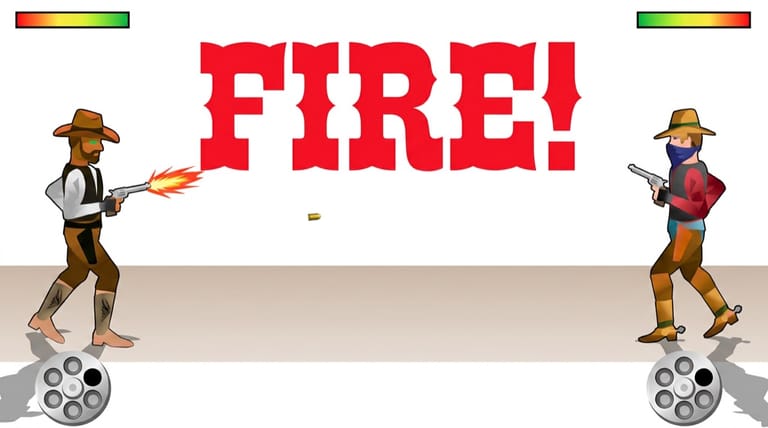
Gunblood is a game about a single moment. Two figures stand at opposite ends of a dusty street, a prompt appears, and whoever reacts faster wins the round — everything else in the game exists to make that instant harder. There is no movement, no cover and no second chance within a round, which makes this one of the purest reaction tests the Flash era produced.
Nine Opponents and a Prompt
You pick from a lineup of ten duellists, each drawn as a Western archetype, and then work through a ladder of nine challengers. The structure never varies: both duellists take their marks, a signal appears on screen, and the round is decided by whose click lands first once it does.
The difficulty ramp is entirely in the opposition's reaction speed. The early challengers leave you a comfortable window; the later ones respond fast enough that any hesitation loses the round outright. Because your own reaction time is a fixed human quantity of roughly a fifth of a second, progress comes from removing everything that adds to it rather than from getting faster in any biological sense.
Controls
| Action | Control |
|---|---|
| Aim and fire | Left mouse button |
The mouse handles everything, including the menus. There is no keyboard input at all.
The Cost of Firing Early
The rule that gives the game its shape is the penalty for drawing before the signal. Anticipating the prompt does not simply waste a shot — it forfeits the round, which removes the obvious cheat of clicking wildly and rewards players who genuinely wait.
That single rule creates real tension. You cannot hedge: committing early is an immediate loss and committing late is a loss on speed, so the correct approach is to sit completely still with a settled cursor and respond to the prompt itself rather than to your own sense of when it is due. Players who lose repeatedly on the later opponents are almost always losing to their own anticipation rather than to the game.
Training the Reaction
A few things measurably help:
- Pre-position the cursor before the round starts. Any distance you have to travel after the signal is added directly to your reaction time. Park it where your shot needs to go, not in the middle of the screen.
- Watch the prompt, not the opponent. Peripheral movement from the other duellist is a distraction that pulls the eye and delays the click.
- Keep your hand relaxed. A tensed hand hovering above the button is slower than a resting one, because the movement has further to travel.
- Do not attempt to predict the timing. The interval before the signal varies, and pattern-hunting is exactly what the early-fire penalty punishes.
- Reset between rounds. Losing a round tends to make the next click premature. One deliberate breath before restarting is worth more than another twenty attempts.
Where This Kind of Game Comes From
The duel has been a video game format since the mid-1970s, when arcade cabinets like Gun Fight put two players at opposite ends of a Western screen. Gunblood, credited to Wolf Games, is a browser descendant of that lineage stripped to its essential mechanic — no movement, no terrain, just the draw. Playing it alongside modern shooters is a useful reminder of how much a game can get out of one input if the rules around that input are tight enough.
The Western setting does most of the atmospheric work. The characters are stock figures from the genre, the presentation is deliberately pulpy, and the whole thing frames what is really a laboratory reaction test as a showdown, which is why it holds attention far longer than an abstract version of the same test would.
A Note on Browser Timing
Running through Flash emulation adds a small amount of input latency compared with the original plugin. It is consistent rather than random, so it does not make the game unfair, but it does mean your first couple of rounds function as calibration. Play a duel or two before judging your timing, and use a wired mouse if you have one, since wireless polling adds a few more milliseconds to a game where milliseconds are the entire subject.
Frequently Asked Questions
How many opponents are there in Gunblood? Nine, faced in sequence, with each challenger reacting faster than the last.
What happens if I fire before the signal? You forfeit the round. The early-draw penalty is what stops players from simply clicking as fast as possible.
How many characters can I choose from? Ten duellists are available in the selection screen. They differ in appearance rather than in how quickly you can react.
Is there any way to make the later duels easier? Only by reducing your own delay: cursor already in position, eyes on the prompt, and no attempt to predict when it will appear.
Does it use the keyboard at all? No. Aiming, firing and every menu are handled entirely with the mouse.