

Keeper of the Grove 2
Loading game…
Keeper of the Grove 2
Most tower defense games end a wave when something reaches your exit. Keeper of the Grove 2 ends it when something leaves with your property. The raiders pouring into the grove are not trying to breach a gate — they are heading for the magic crystals at the heart of the map, and the moment one is picked up, that unit turns around and starts walking it off the screen. Everything about how you build follows from that single change.
Guarding, not gating
Because the threat is theft rather than a breach, your defence has to cover two directions. A wall of towers that shreds enemies on the way in is worthless if a carrier survives long enough to get behind it on the way out, and stopping a carrier before it clears the map means the crystal drops where it fell rather than being returned to you automatically. Losing crystals is survivable but degrading, so the game creates a slow-burn pressure that pure leak-or-don't-leak defence never manages.
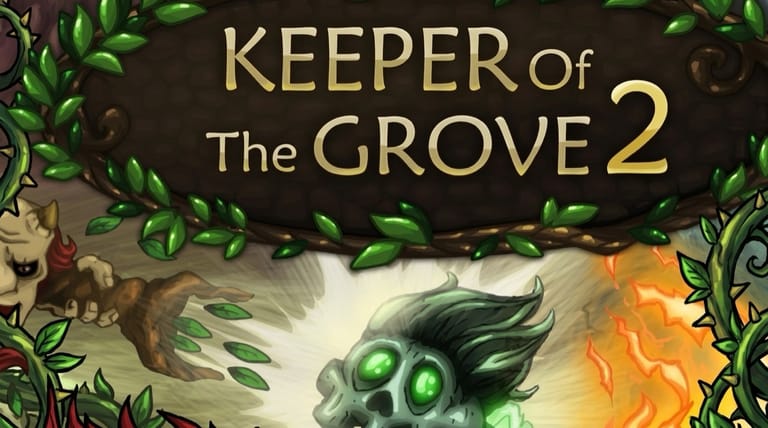
Booblyc released the game for Flash in April 2010, with an HTML5 version following a decade later. The presentation is hand-painted rather than cartoonish: dense green canopy, mossy stonework, warm light through the leaves. It reads as a nature preserve under siege rather than a battlefield.
Stone guardians on fixed ground
You do not build anywhere you like. Each map has a fixed set of nodes, and the decision is which guardian to wake up on each of them. The guardians are living stone creatures aligned to elements, and they differ in the way you would expect from an elemental system: fast single-target damage, slow heavy hits, area effects, and slowing or crowd-control support. Each has its own upgrade path spent from your in-mission income.
On top of the guardians sit spells on cooldowns, which is where your active input goes. Holding a lane, thinning a bunched-up group, or stopping a carrier that is about to escape are all spell jobs. Between missions, points earned from your performance go into a persistent upgrade tree, so a level that stonewalled you becomes tractable after a few runs elsewhere. Levels are also scored, which turns the campaign into a series of optimisation problems rather than a single pass.
Controls
| Action | Control |
|---|---|
| Select a node or guardian | Left mouse button |
| Upgrade or dismiss a guardian | Left mouse button on the on-screen menu |
| Cast a spell | Left mouse button on the spell, then the target |
| Start a wave / menus | Left mouse button |
Reading a map before you build
- Find the crystal, then trace both routes. Work out the path in and the path out. Nodes that cover both are worth far more than nodes that only cover the approach.
- Slow before you damage. Crowd control near the crystal buys your damage guardians the extra seconds they need to kill a carrier before it reaches the edge.
- Do not spread upgrades evenly. Two fully upgraded guardians on good nodes beat five half-built ones almost every time.
- Bank a spell for carriers. It is tempting to spend cooldowns clearing waves, but the emergency you actually need to cover is a single unit walking away with a crystal.
- Farm the talent tree. If a mission is unwinnable with your current unlocks, replay an earlier one for points instead of retrying the wall.
Why it still plays well
2010 was the peak of browser tower defense, and the games that survive from that year are the ones with a real idea rather than a longer wave counter. The stolen-resource objective is Keeper of the Grove 2's idea, and it is a good one: it makes leaks partial rather than fatal, it gives you a reason to build backwards, and it turns every escaping unit into a small decision about whether a cooldown is worth spending. The painted art has also aged better than the era's flat vector look.
Frequently Asked Questions
What are the enemies trying to do? Reach the grove's magic crystals, pick one up, and carry it off the map. Interrupting a carrier is a distinct objective from simply killing enemies on their way in.
Why can I only build in certain spots? Guardian placement is limited to preset nodes on each map. The design intent is that map knowledge and guardian choice matter more than maze-building.
Do upgrades carry between levels? In-mission guardian upgrades reset each map, but the points you earn feed a persistent tree that improves your options across the whole campaign.
Is this a sequel to a Flash original? Yes. It follows the first Keeper of the Grove, and this second game is the one that fleshed out the guardian and spell systems.
What happened to the Flash version? It launched on Flash in April 2010 and was later rebuilt in HTML5. This is the original Flash build, run through a browser-based player.
Are there difficulty modes? Levels are scored on performance rather than gated behind separate difficulty settings, so replaying a cleared map for a better result is the intended challenge.