
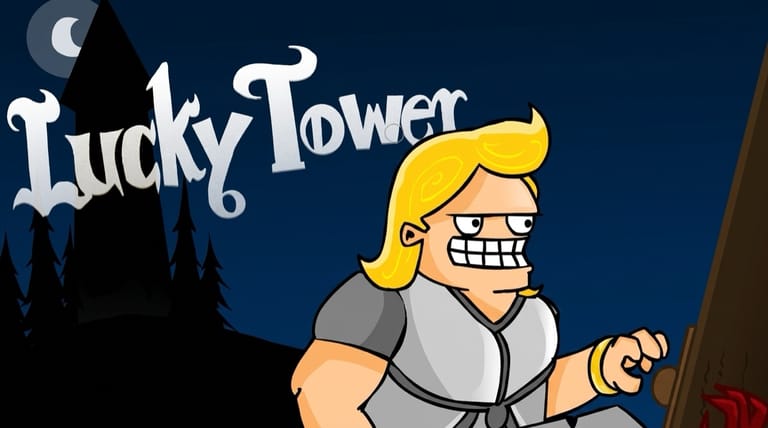

Lucky Tower
Loading game…
Lucky Tower
There is a moment in Lucky Tower where you stand in front of three closed doors knowing that two of them are jokes at your expense, and pick one anyway. The knight cannot see through walls any better than you can. What is behind each door is drawn fresh from the game's pool of rooms — a weapon lying on the floor, a trap that needs a fast reaction, a sight gag that plays out and takes your run with it — and the name is doing the work honestly. Luck decides a lot.
A platformer wearing a slot machine's clothes
Each floor is a corridor with a set of doorways. You walk between them, choose one, and step inside. Some rooms hand you something useful. Some are survivable if you react correctly, and this is where the game stops being pure chance: your knight can jump, swing a weapon, and pick things up, so a hazard you recognise is a hazard you can beat. Others end the attempt with a short animation whose only purpose is to be funnier than it is fair.
That mix — real platforming inputs, randomised content, comic failure — puts it in the same family as the roguelike-adjacent Flash games that were appearing around the turn of the 2010s, but with the numbers filed off. There is no build to optimise and no meta-currency. You just go up until you stop going up.
Items, weapons and knowing what to do with them
Anything you find can matter. Weapons change what you can deal with, since a knight with reach can clear rooms that an unarmed one cannot. Objects can be lifted and used, sometimes in ways the room does not spell out. Because rooms recur across attempts, the game turns into a knowledge game over time: the second time you see a particular setup you already know whether to run, jump, swing or leave.
The trick is that the knowledge only helps if you survive long enough to apply it. A run that hands you nothing for three floors leaves you walking into rooms you know how to beat, without the tool you need to beat them.
Controls
| Action | Control |
|---|---|
| Walk left / right | Left Arrow / Right Arrow |
| Enter a door | Up Arrow |
| Crouch | Down Arrow |
| Jump | A |
| Attack, lift or interact | S |
Improving your odds
- Take every weapon you see. Being armed converts a large share of otherwise fatal rooms into manageable ones.
- Enter, then pause. Do not run forward on entry. Most rooms give you a fraction of a second to read them before anything happens, and using it is free.
- Learn the tells. Recurring rooms have consistent openings. Recognising the first frame of a setup is worth more than any reflex.
- Crouch and jump defensively. The two movement verbs beyond walking exist because certain rooms specifically require them.
- Do not agonise over the choice. Door contents are not signposted. Deliberating between identical doors costs you nothing and gains you nothing — the skill is what you do after you open one.
The comedy of dying a lot
Lucky Tower belongs to a small group of Flash games that treated failure as the reward rather than the punishment. The animations you get for losing are the most carefully made assets in the game, which means every death is content you have not seen before. That flips the usual emotional response: a run ending is mildly disappointing and immediately funny, and the game is short enough to restart before the disappointment registers.
It is also why the game has stayed in circulation. The mechanical part is slight, but the writing and animation carry it, and the randomisation means two people's descriptions of the game rarely match.
Frequently Asked Questions
Is the room behind each door random? Yes. Contents are drawn from a pool each time, so no two runs through the tower are laid out identically.
Can I actually escape the tower? Getting out is the stated goal, and it is possible, but the game is built so that most attempts end early. Expect many short runs before a long one.
Does the knight fight, or only choose doors? Both. You have a jump, an attack and an interact button, and using them well is what turns a dangerous room into a cleared one.
Do I keep items between runs? No. Each attempt starts fresh, so what you carry into a floor is whatever this run has given you.
Is knowing the rooms cheating? It is the intended long-term skill. Room recognition is the only durable advantage the game offers, since nothing else persists between attempts.
Are there sequels? The game spawned follow-ups that expanded the format with more rooms and longer runs. This is the original, and the leanest version of the idea.