
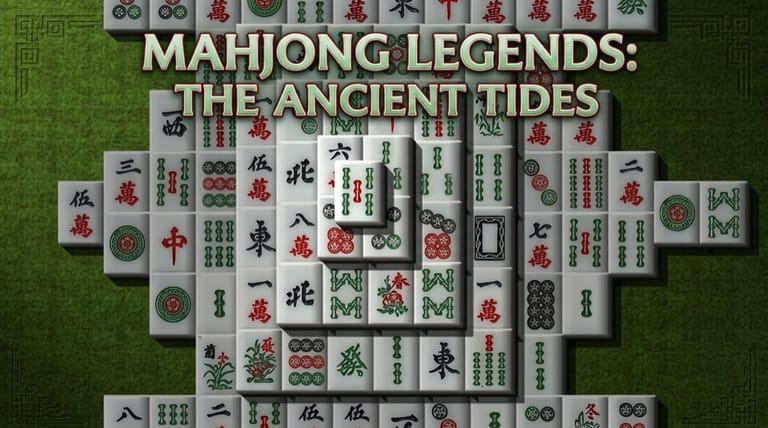

Mahjong 3D Classic
Loading game…
Mahjong 3D Classic
The feature that separates Mahjong 3D Classic from the hundreds of other browser mahjong solitaire games is the editor. Most versions hand you a fixed list of layouts and let you work through them; Mike Dogan's build lets you stack the tiles yourself, save the arrangement, and then play it. If you have ever finished a board and thought the problem was the layout rather than your play, this is the version that lets you test that theory.
Solitaire, not the four-player game
Worth clearing up first, because the names collide: this is mahjong solitaire, a single-player tile-matching puzzle that borrows the tile set from the Chinese four-player game and nothing else. There are no hands, no draws, no scoring for combinations and no opponents. The board is a three-dimensional stack of 144 tiles, and your job is to remove all of them in matching pairs.
The tiles themselves are rendered rather than drawn flat, with real thickness and shading, which is where the "3D" in the title comes from. It makes reading a tall stack easier than the flat-sprite versions manage, because you can see which pieces are sitting on top of which.
The rules that actually decide games
Two conditions govern every move. A tile is selectable only if nothing is stacked on top of it, and only if at least one of its left or right edges is clear. Two selectable tiles that show the same face can be removed together. Bamboo, circles and character suits match exactly. The flower and season tiles are the exception — any flower pairs with any other flower, and the same goes for seasons, which gives you a small amount of flexibility that experienced players save for emergencies.
The failure state is not running out of time; it is running out of legal moves with tiles still on the board. Since each tile face exists four times in the set, choosing which of two identical pairs to clear is the decision that determines whether you finish. Take the wrong pair and the two that remain can end up permanently blocking each other.
Controls
| Action | Control |
|---|---|
| Select a tile | Left mouse button |
| Deselect a tile | Left mouse button on the same tile |
| Menus, tile sets and editor | Left mouse button |
Clearing a board without stalling
- Work from the top down. Tiles higher in the stack unlock the most other tiles when removed. Clearing edges of the bottom layer early gains you almost nothing.
- Look at all four copies before matching. If three of a face are exposed, pick the pair that frees the most tiles and leaves the remaining copy reachable.
- Break up long rows from the ends. A tile buried in the middle of a row is locked until one side is cleared, so work inward rather than picking off scattered singles.
- Hold flowers and seasons back. Their loose matching rules make them the most flexible tiles on the board, and they are worth keeping in reserve for when you are short of options.
- Count what is left of a face. Two identical tiles stacked directly on top of one another are a dead pair. Spotting them early tells you which route through the board is a trap.
Tile sets and the editor
Presentation is adjustable: several tile designs are included, so you can switch between traditional engraved faces and cleaner, higher-contrast sets depending on what you find readable. On a small screen or a low-contrast monitor, that choice genuinely affects how quickly you can scan a board.
The editor is the part worth spending time in. Building your own arrangement teaches the geometry of the puzzle from the other side — you quickly discover that symmetrical, visually impressive stacks are often trivially easy, while awkward asymmetric piles with few open edges are the ones that produce real dead ends. Designing a board that is hard but still solvable is a much better puzzle than clearing one.
Frequently Asked Questions
Is this the same as the four-player mahjong game? No. This is mahjong solitaire, which uses the same tiles but is a single-player matching puzzle with entirely different rules.
How many tiles are on a board? The full set of 144, arranged into a layered stack, with every face appearing four times.
What makes a tile selectable? It must have nothing on top of it and at least one free side, left or right. Tiles that are boxed in on both sides stay locked until a neighbour is removed.
Do flowers and seasons match each other? Any flower matches any other flower, and any season matches any other season. They do not cross-match between the two groups.
What can I do in the editor? Place tiles yourself to build a custom layout, then play it. It is the main thing this version offers over standard mahjong solitaire builds.
What happens if I run out of moves? The board is unsolvable from that point and the deal ends. Avoiding it is the actual skill in mahjong solitaire, which is why match order matters so much.