
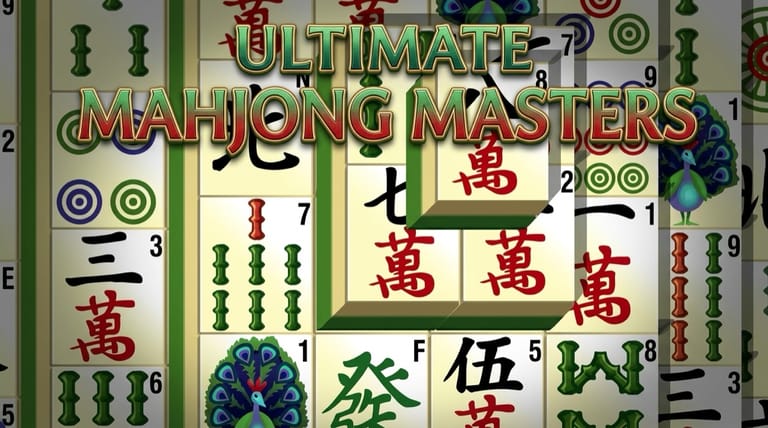

Mahjong Shanghai
Loading game…
Mahjong Shanghai
There is no undo here and no reshuffle. Agame's take on tile solitaire hands you the full traditional arrangement, lets you start clicking, and quietly makes every pair you take permanent. That absence of a safety net is the whole character of the game — it is the version people reach for when they want the puzzle to actually be a puzzle rather than a pleasant way to pass ten minutes.
The Solitaire That Started on a Mainframe
Mahjong itself is a four-player gambling game from nineteenth-century China, and it has very little in common with what happens on this board. The single-player matching game is a much more recent invention: it was written by Brodie Lockard on the PLATO computer network in the early 1980s and reached a mass audience when Activision published it as Shanghai in 1986. That release is the reason an entire genre now carries the name of a Chinese city rather than a description of what you do.
Shanghai was one of the great sleeper hits of the home computer era, ported to almost every machine of its generation, and its influence is why the pyramid-shaped opening arrangement is instantly recognisable to people who have never touched a physical mahjong set. Browser versions like this one inherit that arrangement directly, right down to the 144-tile count of a full set.
Two Modes, Two Difficulty Curves
The mode select is the first meaningful decision. The standard board lays out the complete traditional set, which means five layers, deeply buried tiles, and a real chance of stranding yourself. The lighter mode uses a reduced set on a shallower arrangement, and it exists so that younger or newer players can learn the selection rule without immediately hitting a dead board.
The rule itself is short: a tile can be picked up when nothing sits on top of it and one of its two long sides is unobstructed. Pick two matching free tiles and both leave the board. Everything difficult about the game follows from the fact that removing a tile changes which other tiles are free.
Worth knowing before you commit to the full board: the reduced mode is not simply the same puzzle with fewer pieces. Shallower stacks mean more of the board is legal at any moment, so it forgives bad ordering in a way the full arrangement never will.
Controls
| Action | Control |
|---|---|
| Select tiles | Left mouse button |
| Deselect a highlighted tile | Click it again |
No Shuffle Means Every Click Counts
With no reshuffle available, the skill is entirely in sequencing. A few principles carry most of the weight:
- Work top-down, not left-to-right. The tiles capping the highest point of the arrangement block the most other tiles. Removing them buys you information about what is underneath.
- Watch for three-of-a-kind exposures. Every design exists four times. When three copies are visible at once, the pair you take decides whether the fourth is freed or entombed. Take the two that unblock the most.
- Leave the long tails alone. The rows that stick out at the sides of a traditional arrangement have open ends by definition, so they stay playable to the very end. They are your reserve, not your opening move.
- Count before you clear the last pair of a design. Once all four copies of a tile are gone they can never help you again, which is fine, but doing it early can leave a matching partner buried with nothing to pair it with.
Losing looks like this: a dozen tiles left, all of them legal, and none of them a pair. It is not bad luck so much as a decision you made twenty moves earlier.
Frequently Asked Questions
How many tiles are on the full board? 144, which is the size of a complete traditional mahjong set including the flower and season tiles.
Can I reshuffle when I get stuck? No. This version deliberately leaves out a shuffle, which is why move order matters more here than in versions that let you reset a dead position.
What is the kids mode for? It uses fewer tiles on a shallower arrangement so the selection rule can be learned without the deep stacks of the standard board punishing early mistakes.
Are flowers and seasons matched exactly like the other tiles? No. In a traditional set the four flowers match each other and the four seasons match each other, rather than requiring an identical design.
Is this related to the Activision game called Shanghai? Not directly. It follows the same format that Activision's 1986 release made famous, which is where the name comes from, but it is a separate browser game.