

Mini Putt
Loading game…
Mini Putt
The clever part of Mini Putt is the thing most players click straight past: before every hole you get to choose where the ball goes. Real mini-golf makes you tee off from a fixed mat. Here the tee is a zone, and shifting your ball a few pixels left or right changes which walls you can bank off, which slope you roll across, and whether the hole is a two-shot problem or a four-shot one. Players who treat placement as a formality are giving away strokes before they have swung.
Where You Tee Off Matters
Psycho Goldfish Creative Media's courses are built around rebounds. Very few holes offer a clean straight line from tee to cup, so the intended solution is usually a bank shot off a side wall, and the angle of that bank is set by where your ball starts. Move to the far left of the tee zone and a wall that was unusable opens up a route around an obstacle.
The habit worth forming is to work backwards. Look at the cup, decide which wall you want the ball arriving from, then position the tee so that a single rebound produces that arrival. It takes an extra few seconds and it routinely turns a bogey into a birdie.
Reading the Aim Line
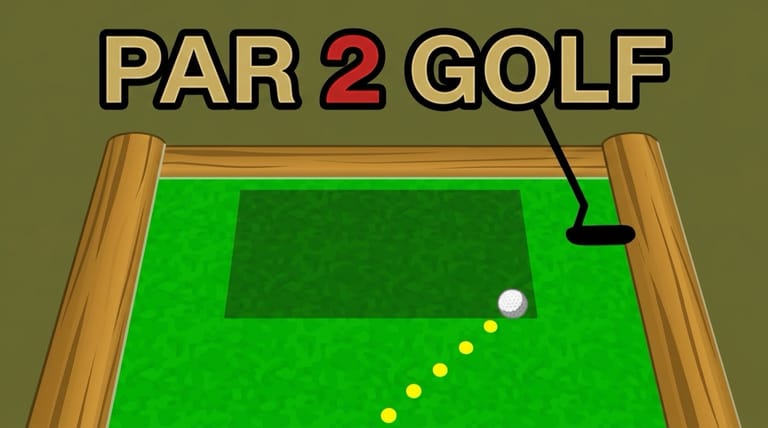
Aiming and power are the same gesture. You drag out a line from the ball: its direction sets the heading, its length sets the strength. Longer line, harder hit. There is no separate power meter to time, which removes the twitch element entirely and makes this a game of judgement rather than reflex.
That judgement is harder than it looks because the physics are unforgiving in one specific way: a ball that is travelling too fast does not sink. It rattles the cup and rolls on. Plenty of missed putts in this game are shots that were aimed perfectly and struck about twenty percent too hard. When you are close, shorten the line more than feels right.
A few things the physics reward:
- Rebounds preserve most of the ball's speed, so a bank shot needs less power than the total distance travelled suggests.
- Slopes act late. A ball moving fast crosses a slope almost straight and then curls once it slows, which means the break happens near the cup rather than at the start of the roll.
- Obstacles are geometry, not obstacles. Windmills, blocks and rails are all surfaces you can use deliberately once you stop treating them as things to avoid.
Controls
| Action | Control |
|---|---|
| Place the ball and take the shot | Left mouse button |
| Set direction and power | Drag the aim line out from the ball |
Shaving Strokes Off a Round
Scoring is straightforward stroke play — every shot counts, holes are scored against par, and the round total is what you compare with friends. Cutting that total comes down to a few disciplines:
- Play for position on hard holes. A deliberate short first shot that leaves an easy straight putt beats an ambitious one that leaves you behind an obstacle.
- Learn each hole's one trick. These courses are designed, not generated, so every hole has an intended route. Once you find it, that hole is worth the same low score every round.
- Aim at the wall, not the cup. For bank shots, pick the exact point on the wall you want to hit and aim there. Aiming vaguely "towards the cup" off a rebound is guesswork.
- Do not over-correct after a miss. If a shot rolled long, take a noticeably shorter line rather than nudging it slightly. Small adjustments to a long drag barely change the outcome.
Mini Putt endures because it is honest: no upgrades, no unlocks, no currency, just a set of well-drawn holes and a score you either beat or you do not. It was the kind of game people kept open in a browser tab to settle arguments in an office, and it works exactly the same way now.
Frequently Asked Questions
How do I control shot power? By how far you drag the aim line. A short line is a soft tap; a long line is a full strike. Direction and power are set in the same motion.
Why does my ball skip over the hole? It arrived too fast. The cup only catches a ball travelling slowly enough to drop, so ease off the power when you are putting from close range.
Does it matter where I place the ball at the start of a hole? A great deal. Placement determines which walls you can bank off and which line you have to the cup, and it is the easiest free improvement available.
How is the final score worked out? Strokes are totalled across the round and measured against par, the same as real mini-golf. Fewer shots is better.
Who developed Mini Putt? Psycho Goldfish Creative Media, whose crazy-golf games were a staple of Flash portals throughout the 2000s.