

Portal 2D
Loading game…
Portal 2D
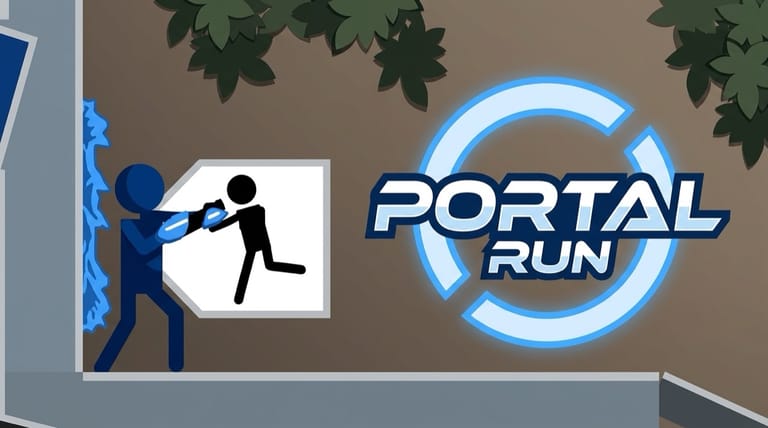
Flattening Portal into two dimensions sounds like it should ruin it, and instead it clarifies it. Seen from the side, you can watch the entire arc of a fling — the drop, the entry, the exit, the trajectory across the room — in a single view, which is something the 3D games never let you do. Portal 2D is an unofficial reimagining built by fans of Valve's puzzle series, and its best moments come from that change of camera rather than in spite of it.
Two Openings, One Space
The core mechanic is unchanged. You place two portals, they link, and anything entering one leaves the other. Only certain surfaces will accept a portal, and identifying which walls in a room are usable is normally the first half of any puzzle — the level designer has already told you where the solution goes by choosing what you are allowed to shoot.
The second rule is the one that turns portals from a teleporter into a physics tool: your speed comes out with you. Fall a long way into a floor portal and you will be launched out of a wall portal at whatever pace you built up. Almost every non-trivial room in a portal game is really asking you to construct enough velocity and then point it somewhere useful.
Controls
| Action | Control |
|---|---|
| Move left / right | A / D or the Left and Right arrow keys |
| Jump | W, Up arrow or Spacebar |
| Fire a portal | Left mouse button, or Q |
| Pick up or drop an object | F |
Aiming with the mouse while running with the keyboard takes a few rooms to settle. The useful habit is placing your exit portal before you start moving, so that the only thing you are doing under time pressure is the entry shot.
Cubes, Switches and Doors
The other half of the puzzle vocabulary is objects. You can pick things up with F and carry them, which means the classic problem of a switch that needs weight on it and a cube that is on the wrong side of a wall. Portals move the cube, or move you and the cube, or let you drop the cube through a portal and catch it somewhere it could not otherwise reach.
A cube keeps its momentum through a portal exactly as you do, which opens up the more interesting version of the puzzle: throwing an object into a portal so that it arrives somewhere you cannot go yourself.
How to Think Through a Room
- Survey before shooting. Find every portal-friendly surface first. The set of legal surfaces is usually a much shorter list than the set of things you could try.
- Work backwards from the exit. Ask where you need to end up and what speed you need to arrive with, then figure out where that speed can come from.
- Height is stored energy. Any ledge you can climb is potential velocity. If a room gives you a long drop, the drop is part of the solution.
- Place the destination portal first. Firing the exit while standing still and the entrance while falling is much easier than the reverse.
- Put the cube down before you experiment. Carrying an object changes what you can reach, and dropping it accidentally mid-fling costs you the setup.
Fan Work, and What It Gets Right
This is a tribute project rather than an official release, and it is worth judging on those terms. It does not have the writing, the voice acting or the production of the games it references, and it is not trying to. What it does have is the physics, and the physics is the part that makes portal puzzles work — the moment where a plan you assembled in your head executes exactly as imagined is intact here.
The side-on view also makes it a much gentler introduction to the concept than the 3D originals. Nobody gets lost, nobody misjudges depth, and a room can be understood at a glance. If portal logic has ever confused you in three dimensions, seeing it laid out flat is a genuinely useful way to learn it.
Frequently Asked Questions
Is this made by Valve? No. It is an unofficial fan game inspired by Valve's Portal series, built independently and not connected to the official releases.
Why won't my portal stick to that wall? Only certain surfaces accept portals. If a shot does nothing, that surface is not part of the intended solution, which is a hint about where the real route is.
How do I gain enough speed to reach a high ledge? Fall into a portal placed on the floor from as high as you can reach, with the paired portal on a wall pointing where you want to go. The drop converts into horizontal launch speed.
Can I move cubes through portals? Yes. Objects obey the same rules you do, including carrying their momentum, so throwing a cube into a portal is often the intended solution rather than a trick.
What is the F key for? Picking up and dropping objects. You hold whatever you are carrying until you press it again, and you can carry an item through a portal with you.