

Riddle School
Loading game…
Riddle School
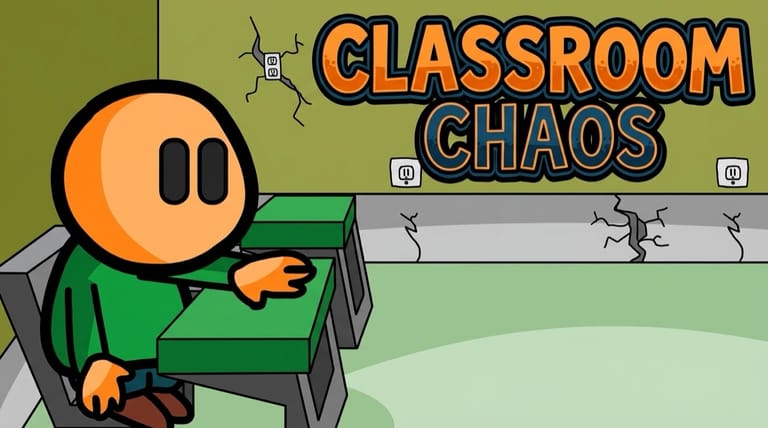
Riddle School opens on a boy called Phil Eggtree slumped at a desk while a teacher drones on, and the entire game is his attempt to be somewhere else. There is no inventory tutorial, no hint system, and no failure state — just a school building, a handful of objects that are not where they should be, and a series of small deceptions you have to string together in the right order.
A Teenager's Game That Started a Series
It was made by JonBro, a hobbyist developer who was still a teenager when the first game went out, and it shows in the best way. The art is flat, bright and unfussy, the animation is minimal, and the writing is the kind of deadpan that only really works when nobody has told the author what a joke is supposed to look like. None of that is a limitation the game is apologising for; it is the aesthetic.
Riddle School did well enough to become a series, running through several sequels and then continuing into the Riddle Transfer games, which take Phil's story somewhere considerably stranger than a classroom. The first entry is where the tone, the protagonist and the escape-the-building structure were established.
How the Puzzles Work
The whole thing runs on point-and-click adventure logic. You click on scenery to examine it, click on people to talk to them, and pick up anything the game lets you pick up. Items collect in an inventory strip, and progress almost always comes from using one of them on something in the world — or, occasionally, on another item.
Controls
| Action | Control |
|---|---|
| Examine or interact | Left mouse button |
| Use an inventory item | Click the item, then click the target |
| Move to another room | Click a doorway or exit |
The puzzle chain is short but it is a chain: each object you acquire exists to unlock the next room or the next conversation, and there is very little in the game that is decoration. If you have picked something up, it has a use.
Getting Unstuck
- Click everything, including the boring parts. Desks, posters and floor tiles hide things, and the game gives no visual cue for what is interactive.
- Re-read your inventory when you stall. Being stuck almost always means you are holding an item you have not tried in the right place yet.
- Talk to people twice. Conversations change after you acquire certain objects, and a character who had nothing to say earlier may now be the solution.
- Think about who you can get rid of. A recurring pattern in the series is that the obstacle is a person watching you, not a locked door.
- Do not brute-force item combinations. The puzzles are logical rather than obscure, and if a solution feels arbitrary it is probably not the intended one.
Why It Still Works
Escape games were everywhere in the mid-2000s and most of them were built around obtuse pixel-hunting. Riddle School is short, fair, and consistently funny, and it respects your time in a way that its contemporaries mostly did not — a first playthrough runs to maybe fifteen minutes, and none of that is spent scrubbing the mouse across a wall.
The other thing it has is a voice. The escalating absurdity of Phil's excuses, the flat delivery of the incidental characters and the sheer pettiness of the goal give it a personality that survived into every sequel. Plenty of people who played it in 2006 can still name the protagonist, which is not something you can say about most fifteen-minute browser games.
Frequently Asked Questions
Who is Phil Eggtree? The student you play as, and the protagonist of the Riddle School series. His only stated motivation in the first game is that class is boring and he would rather leave.
Is this the first game in the series? Yes. Riddle School is the original entry, followed by several numbered sequels and later by the Riddle Transfer games that continue the same character's story.
Is there a way to die or fail? No. There is no timer and no losing state, so you can experiment freely — being stuck is the only real setback.
Do I need to have played anything else first? No. It is self-contained, and the later games' stranger plot developments do not require any knowledge of this one to enjoy, though the running jokes land better in order.
How long is a first run through the school? Around fifteen minutes for most players. Once you know the solutions it collapses to a couple of minutes, which is part of why the sequels leaned harder into fresh puzzles.