
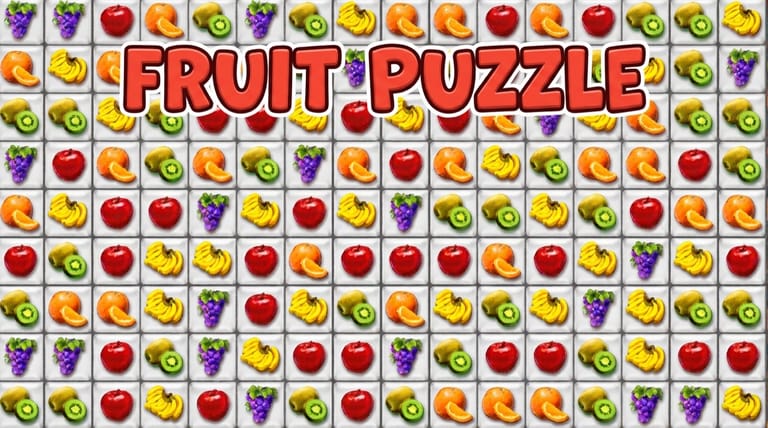

Same Game Fruit Collapse
Loading game…
Same Game Fruit Collapse
The rule takes one sentence to explain: click any group of two or more touching tiles that share a picture and they disappear. Everything difficult about Same Game Fruit Collapse happens after that click, when the tiles above drop into the gap and columns slide sideways to close it. A board you thought you understood rearranges itself, and the group you were saving for later may no longer exist. This is a puzzle about the consequences of gravity, not about spotting matches.
The SameGame Rule Set
The format goes back to a Japanese puzzle called SameGame from the mid-1980s, and dozens of versions have been built on it since. This one dresses the tiles as fruit and adds a bright, unhurried presentation, but the underlying maths is unchanged.
A grid starts full. Tiles count as connected when they touch horizontally or vertically — diagonals do not link. Removing a group scores points, and the score curve is not linear: a group of ten is worth far more than five groups of two. When a column empties completely, the remaining columns close ranks, which is the mechanic that separates this family of puzzles from ordinary match-three.
The round ends when no two adjacent tiles match anywhere on the board. Anything still sitting there counts against you, and clearing the grid entirely is the outcome the scoring is built around.
Why Emptying the Board Is Harder Than It Looks
Every click you make is irreversible and reshapes the geometry for every click after it. Take a small group early and you may split a large cluster in half; the two halves will never touch again. Orphaned single tiles are the usual reason a board stalls out with a dozen fruits left and nothing legal to press.
The counter-intuitive part is that clearing quickly is bad play. Two-tile groups are almost always a waste. Unless you are using one deliberately to drop a tile into place, leaving them alone and hunting for ways to grow a cluster first will finish with both a higher score and a cleaner board.
Controls
| Action | Control |
|---|---|
| Select / interact | Left mouse button |
Hovering over a group highlights it and shows what it is worth before you commit, so use the preview rather than clicking on instinct.
Tactics That Actually Help
- Work from the bottom up. Removing tiles low on the board shifts everything above it. Clearing the top first tends to leave the bottom untouched and unhelpful.
- Protect your biggest colour. Whichever fruit appears most often should be the last one you clear, so it has the most chances to accumulate into one enormous group.
- Use columns as tools. Deliberately emptying a column pushes two distant columns together, which is often the only way to reunite tiles of the same type.
- Count before you click. If a group is worth taking now and will still be there in three moves, take it later.
- Accept the restart. A board that has locked up is a lost board. Reading why it locked is more useful than grinding the remainder.
A Puzzle Built for Short Sessions
There is no timer here, no combo clock and no failure state beyond a poor final score, which makes it an unusually low-pressure puzzle. You can leave a half-solved grid on screen while you think, and thinking is genuinely rewarded — the gap between a careless run and a careful one is large. That combination of a trivially simple rule and a deep decision tree is why the SameGame format has outlived the era it came from.
Frequently Asked Questions
Do diagonally touching fruit count as a match? No. Tiles only connect up, down, left and right, which is why a board can look full of pairs and still be finished.
How is the score calculated? Larger groups are worth disproportionately more than small ones, so a single clear of eight beats four clears of two. Leftover tiles at the end reduce your total.
Is there a bonus for clearing the whole grid? Emptying the board is the best possible result and is rewarded on top of your accumulated points, which is why it is worth playing for the clean sweep rather than fast points.
Can I undo a click? No. Every removal is final, and the board reflow makes it impossible to reconstruct the previous state anyway.
What do I do when no moves are left? That is the end of the round. Start a fresh board and try holding your most common fruit back for longer than you did last time.