

Sprinter
Loading game…
Sprinter
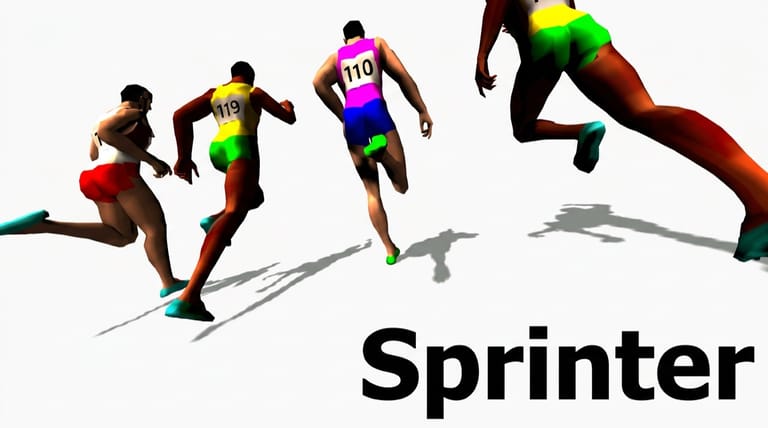
Two keys. That is the whole interface. Sprinter asks you to alternate the left and right arrow keys, over and over, to drive a stick athlete down a hundred metres of track — and it turns out that a rhythm you can perform perfectly for two seconds is very hard to hold for ten. Push too fast and your runner's legs tangle and he goes down face-first. Settle into a pace that is too comfortable and the field pulls away. Finding the line between those two is the entire game.
The Alternating-Key Tradition
Button-mashing athletics is one of the oldest ideas in video games, going back to the arcade track-and-field cabinets of the 1980s, where players wore out buttons and occasionally their hands. Sprinter, made by the Japanese studio Gamedesign.jp, is a lean Flash-era descendant of that lineage. It strips away the field events, the multiple disciplines and the power meters and keeps only the sprint.
What it adds in return is a failure state with teeth. In most mashing games, going too fast is simply impossible. Here, alternating out of rhythm makes the runner stumble, and a stumble at speed sends him sprawling on the track while the rest of the field carries on without him.
Rhythm Over Speed
The mechanic rewards evenness rather than raw frequency. Your runner accelerates when the gap between the left press and the right press stays consistent; two rapid presses followed by a pause reads as a broken stride and costs you momentum. The best times come from a metronome, not a panic.
The meets get progressively more serious as you advance through the career, and the field gets faster with them. An early race can be won on a sloppy rhythm. Later ones will not tolerate a single fumble, and the whole run takes only a handful of seconds, so there is no stretch of track long enough to recover a bad start. One nice touch: each stage has its own piece of music, and once you notice that, the tunes double as a tempo guide.
Controls
| Action | Control |
|---|---|
| Run | Alternate Left and Right arrow keys |
| Select / interact | Left mouse button |
If the arrow keys scroll the page instead of moving your runner, click once inside the game frame to give it keyboard focus.
Running a Cleaner Race
- Count it out. Say "left, right, left, right" in your head at a pace you can genuinely sustain, and hold it rather than accelerating into a mess.
- Use two fingers, not one hand. Index finger on one arrow, middle finger on the other, and let your wrist stay still.
- Do not sprint the first metre. The stumble almost always happens in the opening moments, when the temptation to hammer is strongest and the runner has the least stability.
- Watch the runner, not the crowd. The animation telegraphs a loss of balance a fraction before the fall. Easing off for one beat can save the race.
- Learn the tempo per meet. Because each level demands a slightly higher pace, treat every new race as a fresh calibration rather than repeating what worked last time.
A Few Minutes Well Spent
The whole career runs to a handful of minutes if you are good at it, and Sprinter is not pretending otherwise. Its appeal is the same as a stopwatch app: a very small skill, measured precisely, with immediate feedback on whether you have improved. It is the sort of thing you open intending to try once and close eleven attempts later, having shaved two-tenths off a time nobody else will ever see.
Frequently Asked Questions
Why does my runner keep falling over? Uneven alternation. Pressing the same arrow twice, or letting the gap between presses swing wildly, breaks the stride and trips him. Slow down and keep the interval steady.
Can I use keys other than the arrows? No. The game is built around the left and right arrows specifically, and there is no remapping option.
How long is the full game? Short — a sequence of races that a confident player can clear in a few minutes. The replay value is in improving your times, not in length.
Does mashing as fast as possible work? Not reliably. Beyond a certain rate the runner loses his footing, so the fastest sustainable rhythm beats the fastest raw input.
Is the music different in each race? Yes, every meet has its own theme, and several players use the beat as a natural pacing aid.