

Vector TD
Loading game…
Vector TD
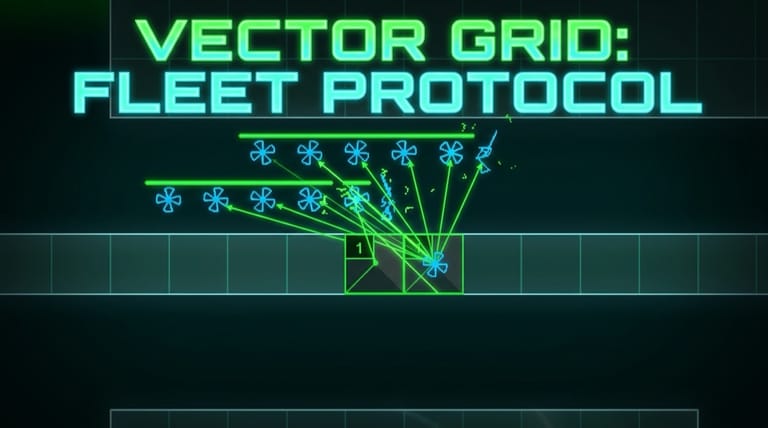
Strip a tower defense game of textures, sprites and scenery and you are left with the part that actually matters: a line, and how long you can make it. Vector TD does exactly that. Everything on screen is a glowing wireframe on black — the field, the towers, the enemies, the range circles — and the absence of decoration makes the geometry impossible to ignore. You are not defending a castle. You are drawing a path and charging admission at every corner.
Wireframes and Glow
David Scott's game arrived when tower defense was exploding out of custom Warcraft III maps and onto Flash portals, and its look set it apart instantly. The neon vector style is not just an aesthetic choice, either. Because every tower is a simple outline with a visible range ring, you can read overlap at a glance — which towers cover a corner, where a stretch of path is uncovered, how far a range upgrade actually extended. Prettier tower defense games hide that information behind art.
The Maze Is the Game
Enemies enter at one edge and head for the other. The field is open ground rather than a fixed track, so towers are also walls: each one you place forces the incoming line to route around it. The only hard rule is that a valid path must always exist. You cannot seal the field completely, and the game will refuse a placement that would.
Everything follows from that. A creep that walks a short straight line spends a couple of seconds under fire; the same creep sent through a switchback of your own design spends twenty. Good players spend their early money buying corners rather than firepower, laying out the skeleton of a long, folded route while waves are still weak, then filling the interior of that maze with towers whose ranges cover several passes of the path at once.
Controls
| Action | Control |
|---|---|
| Select / interact | Left mouse button |
Choose a tower type from the panel and left-click an empty square to build it. Clicking an existing tower opens its upgrade and sell options.
Towers, Upgrades and Coverage
The roster is small and role-based rather than sprawling. There are cheap rapid-fire emplacements that carry the early waves, heavier towers that trade rate of fire for damage against tougher enemies, area-effect options for the waves that arrive in tight clumps, and slowing towers that do little damage themselves but multiply the value of everything nearby by keeping targets inside other towers' ranges for longer.
Upgrading is usually better than expanding. An upgraded tower occupies one square and increases both damage and range, and range is the hidden currency in a maze layout — a tower that reaches three lanes of your switchback is worth three ordinary towers sitting alone. Before you buy anything new, look at where your existing rings already overlap and ask whether another level on one of those would cover the same ground.
Playing for the Number
Vector TD keeps score, and for a large part of its audience the score was the entire reason to play. Surviving is not difficult once you understand mazing; surviving efficiently is. That turns each run into an optimisation problem — how few towers can hold this, how much money can be left unspent, how many lives can be carried intact to the end — and it is why layouts for this game circulated on forums the way speedrun routes do now.
If you want to improve your results:
- Commit to a layout early. Selling towers to reshape a maze mid-run refunds only part of their cost, and that loss shows up directly in your final total.
- Leave gaps you can fill later. A maze built solid from the first wave has nowhere to put the tower you will badly want at wave thirty.
- Watch the leaks, not the kills. One enemy slipping through late is worth more than a dozen early ones, so weight your spending toward the end of the run.
- Count corners. If a new tower does not add a turn to the path or cover an existing one, ask what it is actually buying you.
Frequently Asked Questions
Who made Vector TD? It is the work of David Scott, and its success led to a follow-up that expanded the same wireframe design.
Can I block the enemies in completely? No. The game enforces a route from entry to exit and will not let you place a tower that would seal the field, so the goal is a long path rather than no path.
Should I build more towers or upgrade the ones I have? Upgrade first in most situations. Extra range on a well-placed tower usually covers more of your maze than a new tower squeezed into a spare square.
Do slowing towers do enough damage to be worth a slot? On their own, no. Their value is that they hold enemies inside the firing arcs of everything around them, so place them where your coverage is densest.
What actually determines my score? Efficiency. Getting through the waves matters, but so does how much you spent doing it and how many lives you still hold at the end — which is why the same run can be won twice with very different totals.