

War Mahjong
Loading game…
War Mahjong
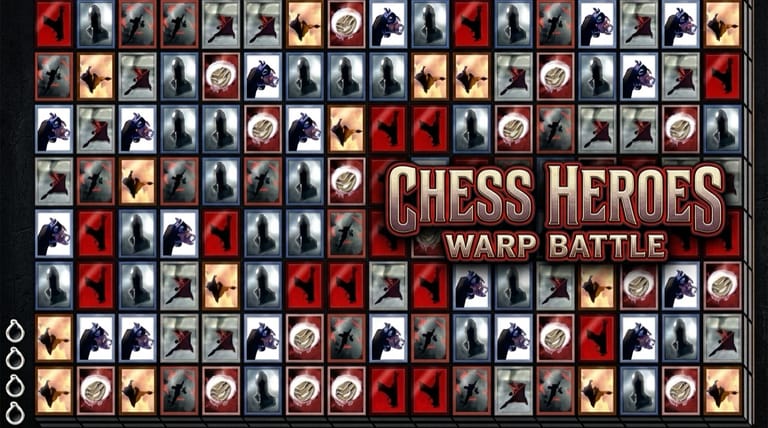
The name sets an expectation that the game immediately breaks. War Mahjong — released in some places as Tiles of the Unexpected — is not the pair-matching layout puzzle the word "mahjong" usually points to. There is no shuffling turtle of stacked tiles and no rule about free edges. Instead you are looking at a dense rectangular field of military artwork, and tiles come off it in groups, not pairs, whenever enough of the same face are touching each other.
What the Board Is Actually Doing
Two layers of tiles sit stacked on top of one another. You clear by clicking a tile that is adjacent to at least one other showing the same face, and the whole connected group of them disappears at once. When tiles are removed from the lower layer, the gap does not stay empty — whatever sits above collapses down into it, rearranging the surface of the board without any input from you.
That collapse is the heart of the game. A single click can drop a dozen tiles into new positions, and if any of them land next to matching faces, they clear too. Chains keep firing until the board settles. It means the tile you click is only half the decision; the other half is what the board is going to look like after gravity has finished.
Controls
| Action | Control |
|---|---|
| Select / interact | Left mouse button |
Click or tap any tile that is sitting next to one or more tiles showing the same face.
The War Theme Is Not Just Skin
The tile faces are drawn from military imagery — insignia, vehicles, equipment and standards rather than the bamboo, circles and characters of a traditional set. It matters more than decoration usually does here, because you are pattern-matching at speed across a crowded grid. The designs are chunky and high-contrast so that a cluster of the same face reads as a shape from across the board, which is exactly what you need when a cascade has just reshuffled forty tiles and you have to find the next move in a layout you have never seen before.
Bombs and the Dead Board
Cascades pay out. Chain enough clears together and the game awards bombs, which remove a single tile of your choosing regardless of whether it has a neighbour to match.
Bombs exist because of how these boards end. Group-clearing puzzles almost always leave a scattering of orphaned tiles with no partner in reach, and without a way to break that stalemate the board would simply be unfinishable. A bomb pulls one tile out of the way, gravity shifts everything around it, and a board that looked finished suddenly has three or four moves in it again. Spending them early to save a few seconds is the single most common way to lose a level you could have cleared.
Reading the Board Before You Click
- Work from the bottom. Clearing low tiles makes everything above them fall, which produces the long chains. Clearing the top row just removes tiles and changes nothing underneath.
- Leave large clusters alone at first. A big group of one face is a safe move that will still be there later. Take the awkward, isolated pairs while there is still room on the board to recover from a bad collapse.
- Look one step past the click. Before committing, check what is directly above the group you are about to remove — that is what is going to land in the hole.
- Bank your bombs. Treat them as the tool for the last twenty tiles, not as a shortcut through the first hundred.
- Do not rush a settled board. The layout only changes when you act, so there is no penalty for spending a moment scanning the whole field for the move that starts the biggest chain.
Frequently Asked Questions
Is War Mahjong the same as regular mahjong solitaire? No. There are no free-edge rules and no matching pairs. You clear connected groups of identical tiles and the board collapses into the space they leave behind.
Why is the game also called Tiles of the Unexpected? That is the title it shipped under in some places, and it describes the design well — the unpredictable part is what the board looks like after each collapse.
How do I earn bombs? They come from chaining clears together. The bigger the cascade a single click sets off, the more likely you are to be rewarded.
What do I do when there are no matching tiles left? Use a bomb. Removing one tile shifts the layer above it and usually opens up matches that were not there a moment before.
Why did clearing a tile change the other side of the board? Because both layers are in play. Removing lower tiles lets upper ones fall, and a chain reaction can travel a long way from where you clicked.