

World's Hardest Game 2
Loading game…
World's Hardest Game 2
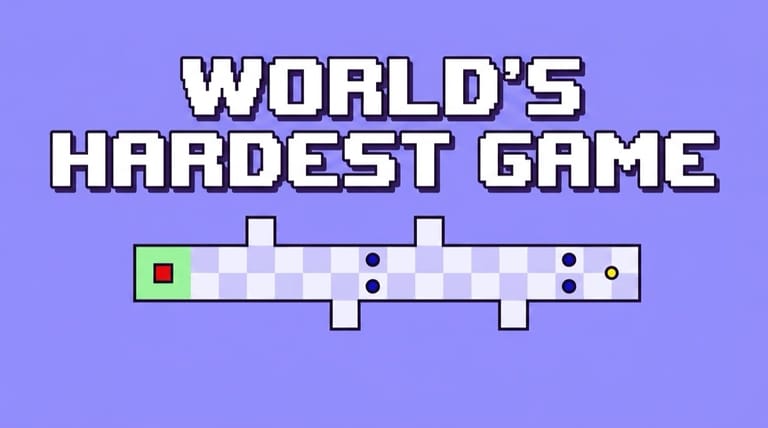
Sequels to precision games usually go wrong by adding things. World's Hardest Game 2 adds almost nothing — the square still moves at one speed, the circles still delete you on contact, the coins still gate the exit — and instead spends its effort on the only variable that was ever going to matter: the arenas. Stephen Critoph's follow-up is the same twenty seconds of concentration, aimed at layouts that have clearly been designed by someone who watched people beat the first game.
What the Sequel Does Differently
The obvious change is that you can steer with WASD as well as the arrow keys, which sounds trivial until you are threading a diagonal.
The real difference is in obstacle behaviour. Where the original leaned heavily on circles sliding back and forth along a line, the sequel builds formations that rotate, circle a fixed point, and trace closed circuits around the arena. A rotating cluster does not present a rhythm you can count — it presents a moving gap that opens in a different place each time it comes around, and reading it requires you to watch the shape rather than the beat.
Arenas are also wider and more likely to be split into distinct sections joined by a safe zone in the middle. That structure changes how a level feels to attempt. The first game usually asked for one continuous plan; here you are more often clearing a stage, breathing, and then starting a second problem you can now see properly for the first time.
Controls
| Action | Control |
|---|---|
| Move | Arrow keys |
| Move | W A S D |
Movement is four-directional at a constant rate. Holding two keys gives you a diagonal, which travels the same distance per frame in each axis — useful for cutting a corner, dangerous for judging a gap.
Reading Patterns Instead of Reacting
Reflexes will carry you through the opening levels and then stop working. Everything on screen is deterministic, so the skill the game is actually training is observation.
Before your first move on a new level, stand in the start zone and simply watch. Nothing can touch you there and the game does not hurry you. What you are looking for is the cycle: how long the whole arrangement of obstacles takes to return to the position it is in right now. Almost every level has one, and once you can see it you stop guessing and start choosing a moment.
Then pick your reference. Do not try to track every circle — track the one that will kill you next, and use a second, slower obstacle as a clock for when to commit. Experienced players effectively reduce a busy screen to two moving objects and ignore the rest until they are past them.
A Routine for a Level That Will Not Fall
- Map the coins first. Work out the collection order before you worry about survival. The route is dictated by where the coins are, not by the shortest path to the exit.
- Break the level into moves. A move is one commitment from safety to safety — a dash across a lane, a step into an alcove. Solve one at a time and stop trying to plan the whole level in advance.
- Fail deliberately. If you cannot tell whether a gap is passable, run at it on purpose to find out. You lose two seconds and gain a fact.
- Practice the ending. The last section is the one you reach least often and therefore know worst. Take the extra beat in the safe zone to watch it properly instead of rushing the finish.
- Stop when you get sloppy. Failures that cluster together usually mean your timing has drifted, not that the level got harder.
Where Players Go Wrong
- Moving before the coin route is decided, then having to double back through traffic.
- Hugging the edge of a safe zone. The boundary is exact, and standing on it means the first frame of your dash is already inside a circle's path.
- Trying to outrun a rotating formation instead of waiting one full cycle for the gap to come to you.
- Treating the fail counter as pressure. It only ever goes up, for everyone.
Frequently Asked Questions
Do I need to finish the first game before this one? No. The sequel explains itself in its opening level and there is no continuing story between the two.
Can I use WASD instead of the arrow keys? Yes. Both schemes are supported and work identically, so use whichever keeps your hand comfortable for long attempts.
Are the levels harder than the original? The arenas are more elaborate, with rotating obstacle formations and multi-section layouts, though the difficulty still ramps up gradually from the opening stages.
Does moving diagonally make me faster? It moves you in both axes at once, which covers ground efficiently, but it also makes your position harder to judge against a narrow gap. Use it on open stretches and single-axis movement in tight ones.
Why do I keep dying in the same spot? Almost always because you are committing on reaction rather than on the pattern's cycle. Wait in safety for a full rotation and identify the exact moment the gap opens before you move.