

World's Hardest Game
Loading game…
World's Hardest Game
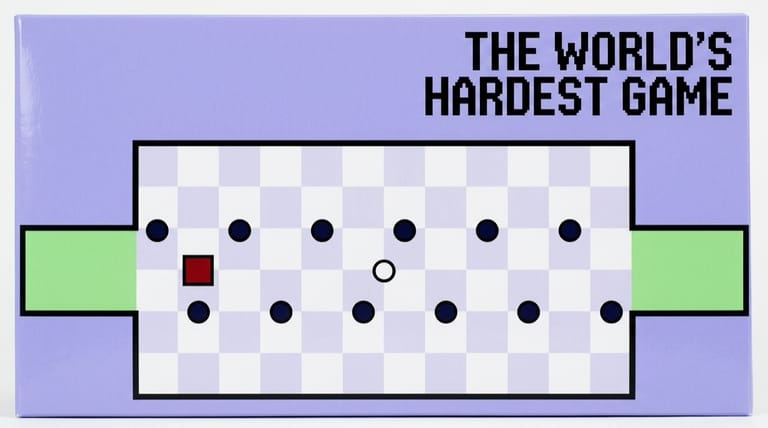
A red square. Blue circles that never change their path. Yellow coins you have to collect before the exit will take you. That is the entire vocabulary of The World's Hardest Game, and it is why the title stopped being a boast about two levels in. There is no health bar, no power-up and nothing to unlock — touching a circle sends you back to the start of the level and the counter in the corner ticks up one more time.
Where It Came From
The game was made by Stephen Critoph and released through his site Snubby Land in 2008, at the point when a single Flash file could travel across the entire internet in a week. It did. Within months it was on every portal and every school computer that had not blocked them yet, and it arrived with a reputation attached: people played it because someone had told them it could not be done.
Critoph understood exactly what he had built. The screens between levels taunt you directly, congratulating your progress in a tone that makes clear it expects you back at the start shortly. That voice is a large part of why the game lodged in a generation's memory. Plenty of Flash games were difficult. This one was difficult and openly amused about it.
The Rules Fit on One Line
You move a red square around a flat arena drawn on a blue-and-white chequered grid. Blue circles patrol fixed routes at fixed speeds. Yellow coins are scattered around the level and every one of them must be collected before the green end zone will accept you. Green areas are safe ground where nothing can reach you.
There are thirty levels. The first is a corridor with two columns of circles sliding up and down, and it exists to teach you the timing. By the tenth, arenas are splitting into chambers connected by gaps a square's width across, coins are placed deliberately inside the paths of moving obstacles, and the safe zones have shrunk to almost nothing. The last handful ask you to hold a plan in your head for thirty unbroken seconds while every part of it has to be executed to the frame.
Controls
| Action | Control |
|---|---|
| Move | Arrow keys |
Four directions, constant speed, no acceleration and no jump. Diagonal movement comes from holding two keys at once and is often the only way through a closing gap.
Why the Difficulty Feels Fair
Nothing in the game is random. Every circle follows the same loop at the same rate on every attempt, so a level that killed you forty times is not testing your luck — it is testing whether you have worked out the pattern and can perform it. That determinism is what separates The World's Hardest Game from games that are merely punishing. When you fail, the reason is visible and specific: you left the safe zone half a second early, or you took the outside line around a rotating pair when the inside was open.
The design also refuses to pad. Levels are short. A run at level 12 takes twenty seconds if it goes well, which means the cost of failure is trivial and you are back in the same spot before frustration can settle. That fast reset loop is the reason people ground out all thirty levels rather than closing the tab.
The Death Counter as a Design Choice
The fail counter is always on screen and it never resets. Most games would hide that number. Here it becomes the score — the thing you screenshot, the thing you compare, the reason to replay after you have already finished. It reframes dying as progress rather than punishment, and it is the single smartest decision in a game with almost no other systems to speak of.
Played today, it holds up better than most of its contemporaries precisely because it has nothing to date. There is no story, no era-specific humour in the mechanics and no dependence on hardware. A square, some circles, and a rule you understood before the first screen finished loading.
Frequently Asked Questions
Who made The World's Hardest Game? Stephen Critoph, who published it through Snubby Land in 2008.
How many levels are there? Thirty. They run continuously, and the game keeps your position so you resume at the level you reached rather than starting over.
Do I have to collect every yellow coin? Yes. The green exit zone will not register until the last coin on the level has been picked up, which is often the hardest part of the route rather than reaching the end itself.
Is there any way to survive touching a blue circle? No. Contact is an instant reset to the beginning of the current level — there is no invulnerability, no shield and no partial credit for how far you got.
What does the counter in the corner track? Total failed attempts. It carries across the whole run and is the closest thing the game has to a score.
Are the obstacle patterns random? Never. Every circle repeats the same movement at the same speed each time, which is what makes memorising a route possible.